
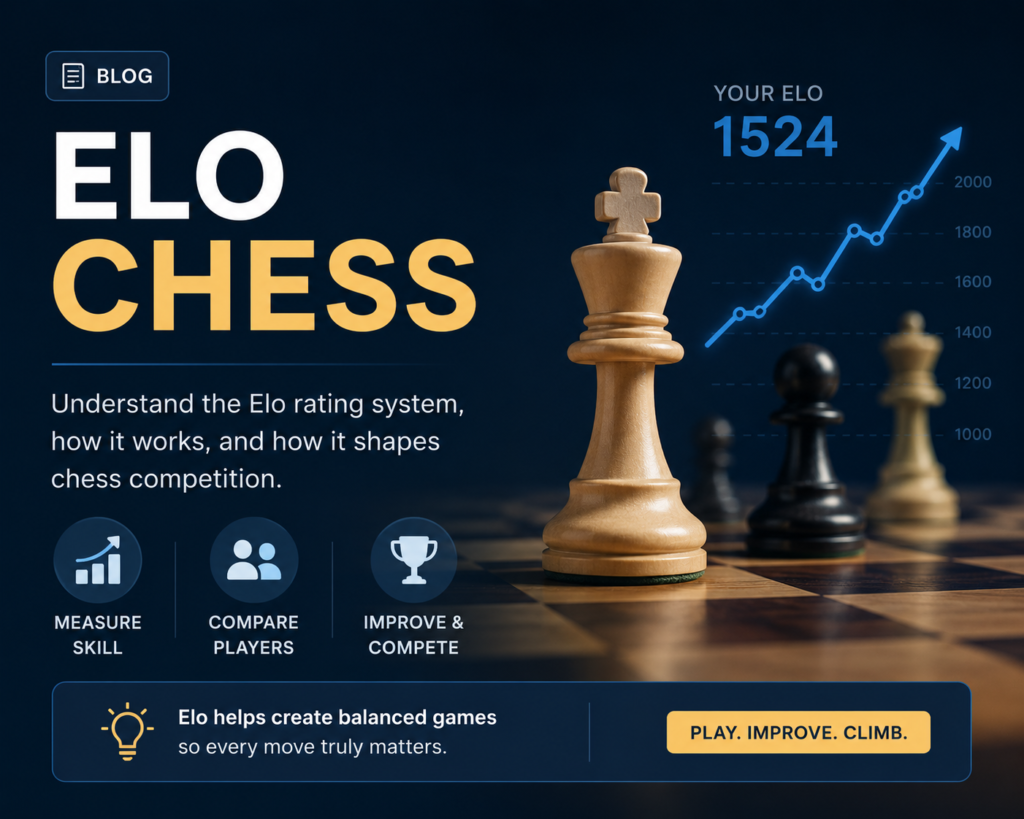
Elo Chess If someone has ever browsed a chess platform and wondered what that number next to a player’s name actually means, they are not alone. That number is called an Elo rating, and it tells a surprisingly rich story about a player’s journey through the game. Understanding the Elo chess meaning is one of the first steps toward thinking about chess not just as a pastime but as a measurable, improvable skill.
The Man Behind the Number
Before diving into what the rating means, it helps to know where it came from. Árpád Elo was a Hungarian-born physics professor who later emigrated to the United States.
He was a passionate chess player and, more importantly, a thinker who believed that measuring skill in competitive games should be rooted in mathematics rather than guesswork.
In the late 1950s, the chess world was using a rating method that many felt was inconsistent and unfair. Elo chess saw the flaws clearly and set out to design something better. His solution was a probabilistic model — a system that did not just record wins and losses, but predicted the likelihood of each outcome based on the gap between two players’ ratings, and then adjusted those ratings accordingly.
Elo Chess the United States Chess Federation embraced his system in 1960. A decade later, FIDE — the body that governs international chess — made it the global standard. What started as one professor’s thoughtful project became the backbone of competitive chess worldwide.
Breaking Down the Elo Chess Meaning
So what does the Elo chess meaning actually come down to? In plain terms, it is a number that reflects how well a player performs against other rated players over time. The higher the number, the stronger the player is relative to their peers.
But there is an important nuance here. The Elo rating is not a fixed label. It moves — upward when a player performs better than expected, and downward when they fall short. This makes the system dynamic and self-correcting. A player who genuinely improves will see their number climb, and one who has peaked will find it stabilizing naturally.
Elo Chess
Another thing worth understanding is that the Elo system is relative, not absolute. A rating of 1500 does not mean a player has mastered 1500 units of chess knowledge. It means that, within the population of rated players on a given platform or federation, that person sits at a particular percentile. The number only has meaning in comparison to other numbers within the same system.
How the Rating Actually Works
The math behind the Elo system can feel intimidating at first glance, but the underlying logic is quite straightforward once broken down.
Predicting the Outcome Before the Game
Every time two rated players sit across from each other, the system already has an expectation of who will win. This expectation is based entirely on the difference between their ratings. A player rated 400 points higher than their opponent is expected to win the vast majority of the time. A player who is only 50 points ahead of their opponent faces a much more even contest, at least statistically.
These expectations are expressed as probabilities. If Player A is expected to score 0.75 — meaning win 75% of the time in equivalent games — and Player B is expected to score 0.25, those numbers will be used to calculate how many points change hands after the game.
Elo Chess
What Happens After the Result
Once the game ends, the actual result is compared to the predicted result. Win = 1 point, draw = 0.5, loss = 0. The difference between what happened and what was expected, multiplied by a factor called the K-factor, determines the rating change.
A player who pulls off a surprising upset against a much higher-rated opponent will gain far more points than someone who wins a game they were already heavily favored to win. This is one of the system’s most elegant features — it rewards genuine overperformance rather than just accumulating games.
The Role of the K-Factor
The K-factor is a multiplier that controls how dramatically a single game can shift a player’s rating. Beginners and younger players typically carry a higher K-factor because their true strength is still being established. A few impressive results early in a chess career can send their rating climbing quickly to a more accurate level.
At the top of the game, elite players carry a lower K-factor. This reflects the idea that a grandmaster’s rating has already converged on a realistic estimate of their strength, so individual results should nudge it only slightly rather than swing it dramatically.
What the Numbers Actually Look Like in Practice
One of the most useful ways to understand the Elo chess meaning is to look at what different rating ranges represent in terms of real playing strength.
The Early Stages: Under 1200
Players in this range are working through the foundational phase of chess. They are learning how pieces move, what checkmate looks like, and why leaving pieces undefended leads to quick losses. Games at this level often end through basic mistakes rather than sophisticated play, and that is completely normal. Everyone who ever reached a high rating passed through this stage.
Finding Footing: 1200 to 1500
Something starts clicking at this level. Players begin to recognize simple tactical patterns — a fork here, a pin there. Opening play becomes more intentional even if not yet deeply studied. The improvements at this stage often come fast because there is so much low-hanging fruit to pick up through basic study.
The Club Player Zone: 1500 to 1800
This is where a large portion of dedicated recreational players spend most of their chess lives. Tactical awareness is solid, positional ideas are starting to make sense, and games are more coherent from start to finish. Progress here requires more deliberate work — patching blind spots, studying endgames, and learning to calculate variations accurately.
Serious Competition: 1800 to 2200
Players at this level have genuinely invested in chess. They study, they review their games, and they understand the game at a structural level that casual players do not. Reaching 2000 is often considered a landmark milestone in a serious player’s development. The Expert title (in USCF) and Candidate Master title (in FIDE) live in this range.
Elite Territory: 2200 to 2400
Reaching FIDE Master or working toward an International Master norm puts a player in rarified company. These players compete in serious tournaments, understand deep opening theory, and handle endgames with precision. Getting here takes years of disciplined, structured effort.
Grandmaster and Beyond: 2500 and Above
The Grandmaster title sits atop the chess world. Earning it requires not just a high rating but achieving specific performance benchmarks in prestigious tournaments. Players above 2700 are considered super-grandmasters, and those who have touched 2800 or beyond — a level only a handful of players in history have reached — represent chess at its absolute ceiling.
Why This System Earned Global Trust
What makes the Elo system so enduring is that it is remarkably fair. It does not care about a player’s age, background, nationality, or how long they have been playing. It responds only to performance. A teenager who outperforms expectations climbs. A veteran who is past their peak gradually descends. The system has no sentiment.
It also scales beautifully. The same mathematical framework works just as well for a local club tournament with twelve participants as it does for a world championship event. That consistency is rare in any measurement system and is a big part of why Elo’s work has proven so durable across more than six decades.
Common Misunderstandings Worth Clearing Up
A few stubborn myths tend to follow the Elo rating system around, and they are worth addressing directly.
The first is the belief that ratings from one platform carry over to another. They do not. A 1600 on Chess.com, a 1600 on Lichess, and a 1600 FIDE rating are three entirely different things. Each system calibrates itself based on its own player pool. Cross-platform comparisons can be roughly directional but should never be taken literally.
The second myth is that playing more games automatically improves ratings. Volume without improvement does nothing .Elo Chess In fact, a player who plays hundreds of games without studying between them may find their rating oscillating around the same number indefinitely. Growth comes from understanding, not repetition alone.
The third misconception is that a rating drop means a player has somehow gotten worse. Short-term fluctuations are a normal part of any competitive rating system. Elo Chess A bad tournament, some unfamiliar opponents, or a run of bad luck in sharp positions can all cause temporary dips. Long-term trends matter far more than any single swing.
Practical Ways to Push the Rating Upward
For those actively trying to climb, the path forward is well-documented by those who have walked it.
Tactical puzzles remain the single most effective tool for rapid improvement at any level below 2000. Doing puzzles daily sharpens pattern recognition in a way that translates directly into better game results. The key is to focus on quality of thinking rather than speed — understanding why a move works matters more than solving it quickly.
Studying complete games played by stronger players teaches something that puzzles alone cannot: how strong players think when there is no obvious tactic available. Elo Chess Positional judgment, long-term planning, and piece coordination all become clearer when observed in context.
Working on endgames is the area most improving players underinvest in relative to its payoff. Knowing how to convert a winning endgame cleanly, or how to hold a difficult one as the defender, can turn what would have been a half-point into a full point many times over a tournament season.
A Final Word
The Elo chess meaning is, at heart, a story about accountability and growth. It gives every chess player — from the eight-year-old learning in a school club to the professional competing for a world title — a common language to measure where they stand and how far they have come.
Arpad Elo built something that outlasted his own era. His system did not just solve a problem for chess. It gave competitive measurement itself a new blueprint, one that has been borrowed by gaming companies, sports scientists, and data analysts ever since. For anyone serious about chess, understanding the Elo rating is not optional — it is the first step toward understanding the game itself.
Pingback: RE2 Remake Chess Puzzle: A Deep Dive Into Modern Chess Gaming Innovation - Chess Next Move - Best next move calculator
Pingback: RE2 Chess Puzzle 2nd Run: A Complete Guide to Solving the Monitor Room Mystery [1] - Chess Next Move - Best next move calculator