
Chess pieces movement is one of those timeless games that has fascinated minds for centuries. Whether someone is picking up a chess set for the very first time or brushing up on the fundamentals, understanding chess pieces movement is the single most important step toward becoming a confident player. Each piece on the board has its own personality, its own rules, and its own role in the grand strategy of the game. Once a player wraps their head around how every piece moves, the whole game starts to make a lot more sense.
This guide walks through each chess piece in a clear, approachable way — breaking down how they move, why they move that way, and how that movement shapes the game.
The Chessboard: Setting the Stage for Movement
Before diving into the individual chess pieces movement, it helps to understand the battlefield. A standard chessboard consists of 64 squares arranged in an 8×8 grid. chess pieces Movement in chess The squares alternate between light and dark colors Each player begins with 16 pieces — a king, a queen, two rooks, two bishops, two knights, and eight pawns.
.
Every piece begins in a fixed position, and the goal of the game is to use each piece’s unique movement to checkmate the opponent’s king. Knowing the movement rules isn’t just about following the rules — it’s about unlocking strategy.
How the King Moves
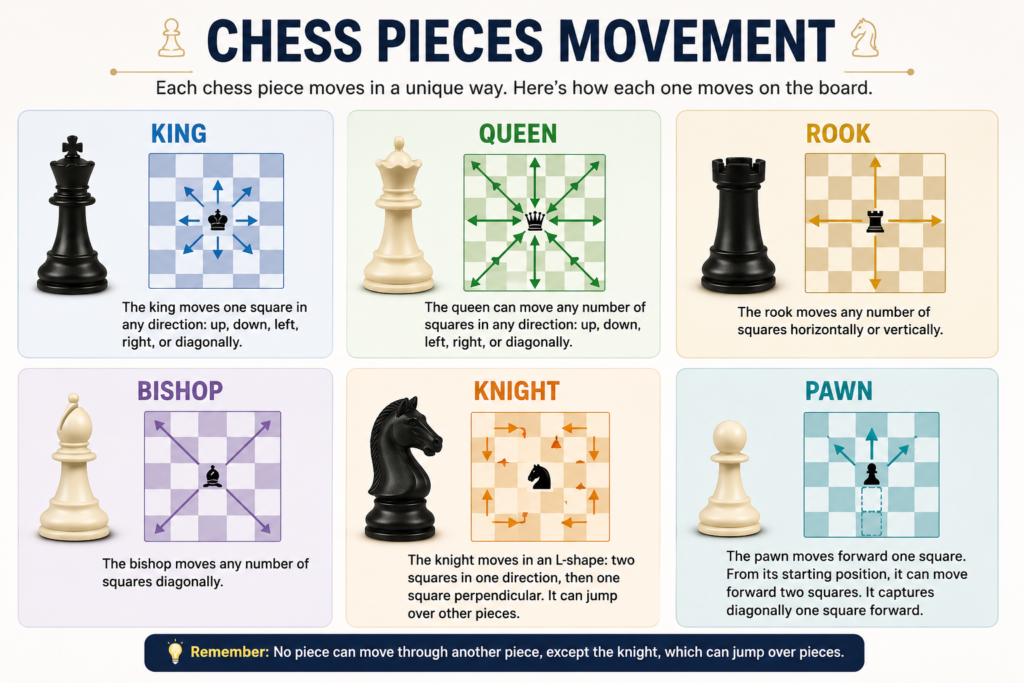
The king is the most important piece on the board, even though it’s not the most powerful in terms of mobility. The king can move exactly one square in any direction — forward, backward, sideways, or diagonally. That gives it up to eight possible squares to step into, as long as those squares are not occupied by friendly pieces or controlled by the enemy.
Because of its limited range, the king relies heavily on other pieces for protection during the opening and middle game. However, in the endgame, the king transforms into an active piece that can and should move toward the center to help control key squares.
One special move involving the king is castling — a defensive maneuver where the king slides two squares toward a rook, and the rook jumps to the other side of the king. Castling is only allowed if neither piece has moved yet, there are no pieces between them, and the king is not in check.
How the Queen Moves
The queen is widely considered the most powerful piece in chess, and its movement rules explain exactly why. The queen can move any number of squares in any direction — horizontally, vertically, or diagonally — as long as no piece is blocking its path.
In terms of chess pieces movement, the queen essentially combines the powers of the rook and the bishop. This makes it an incredibly versatile weapon in both attack and defense. However, bringing the queen out too early can be risky, as it becomes a target for the opponent’s pieces and can waste valuable development time.
Skilled players use the queen to create threats from a distance, support other pieces, and deliver checkmates. Losing the queen is almost always a game-changing event.
How the Rook Moves
The rook is a straight-line powerhouse. It moves any number of squares horizontally or vertically, making it particularly effective in open files and ranks — columns and rows with no pawns blocking the path.
Rooks tend to come into their own in the endgame, when the board is more open and they can dominate entire rows or columns. Two rooks working together on the seventh rank (the row just before the opponent’s back rank) are notoriously difficult to deal withchess pieces movement.
The rook also participates in the castling move alongside the king, as mentioned earlier. One of the key strategic principles in chess is to connect the rooks — meaning to clear the pieces between them so they can support each other on the back rank.
How the Bishop Moves
The bishop moves diagonally, and it can travel any number of squares in that diagonal direction. Each player starts with two bishops — one on a light square and one on a dark square. Because a bishop always stays on its starting color, the light-squared bishop and the dark-squared bishop never interact with each other directly.
This limitation is what makes the bishop both fascinating and sometimes frustrating. A bishop locked behind its own pawns is often referred to as a “bad bishop” — it has little scope and contributes minimally to the game. On the other hand, an open diagonal can turn a bishop into a long-range sniper capable of threatening pieces across the entire board.
Bishops are considered roughly equal to knights in value, though their effectiveness depends heavily on the pawn structure.
How the Knight Moves
If there’s one chess piece that surprises beginners the most, it’s the knight. Unlike every other piece, the knight doesn’t move in a straight line or a diagonal — it moves in an “L” shape: two squares in one direction and then one square perpendicular, or one square in one direction and two squares perpendicular.
What makes the knight truly unique is that it’s the only piece that can jump over other pieces. It doesn’t matter what’s standing between the knight and its destination — the knight hops right over. This makes it especially valuable in closed positions where other pieces are blocked by pawns.
Knights are tricky to play against because their movement is less intuitive. A knight placed in the center of the board can control up to eight squares simultaneously, making central knight placement a key strategic goal.
How the Pawn Moves
The pawn has the most complex and nuanced movement rules of all the chess pieces, which is surprising given that it looks like the simplest piece on the board.
Here’s what makes pawn movement interesting:
- Forward movement: A pawn moves one square forward on each turn. However, on its very first move, it has the option to advance two squares forward instead.
- Capturing: Unlike all other pieces, a pawn does not capture the same way it moves. A pawn captures diagonally — one square forward and to either side.
- En passant: This is a special capture that can occur when a pawn advances two squares from its starting position and lands beside an opponent’s pawn. The opponent has the option to capture it as if it had only moved one square. This move must be made immediately or the opportunity is lost.
- Promotion: When a pawn reaches the far end of the board (the opponent’s back rank), it must be promoted. The player can choose to replace it with a queen, rook, bishop, or knight — and almost always chooses the queen.
Pawns are the soul of chess, as the legendary player Philidor once noted. Their structure determines the character of the position and influences how all the other pieces move.
Special Moves Worth Knowing
Beyond the standard chess pieces movement, there are a few special moves that every player should understand:
Castling
As covered earlier, castling is a move involving the king and a rook. It serves two purposes: it tucks the king away safely behind a wall of pawns, and it activates the rook by moving it toward the center. There are two types — kingside castling (short castling) and queenside castling (long castling).
En Passant
This pawn-specific move is often forgotten by beginners. It’s a one-time opportunity to capture a pawn that has just moved two squares, and it can significantly alter pawn structure.
Pawn Promotion
When a pawn successfully marches all the way to the back rank, it gets promoted. This moment can completely shift the balance of a game, especially in endgames where one side promotes to a queen.
Why Understanding Chess Pieces Movement Matters
Knowing how each piece moves is just the beginning. The real power comes from understanding why pieces are placed where they are and how their movement potential shapes strategy.
For example:
- Rooks belong on open files where they can move freely.
- Bishops shine on open diagonals with no blocked pawns.
- Knights are most effective in closed positions and at the center of the board.
- The queen should be developed carefully, not rushed out early.
- Pawns should be advanced thoughtfully, as they cannot move backward.
Every chess piece’s movement tells a story about what it can contribute to the position. Learning to read those stories is what separates a beginner from a developing player.
A Quick Reference: Chess Pieces Movement at a Glance
| Piece | Movement | Special Rules |
|---|---|---|
| King | One square, any direction | Castling |
| Queen | Any number of squares, any direction | None |
| Rook | Any number of squares, horizontal/vertical | Castling |
| Bishop | Any number of squares, diagonal | Stays on one color |
| Knight | “L” shape, jumps over pieces | None |
| Pawn | One square forward (two on first move), captures diagonally | En passant, Promotion |
Final Thoughts
Chess pieces movement is the foundation of everything in chess. From the humble pawn marching toward promotion to the powerful queen sweeping across the board, each piece plays a vital role in the game’s unfolding drama. Players who invest time in truly understanding not just how pieces move, but why and when to move themchess pieces movement, will find their game improving rapidly chess pieces movement
Chess is a game of infinite possibilities, and it all starts with these movement rules. Once mastered, a whole world of tactics, strategies, and beautiful combinations opens up — and the real journey begins.