
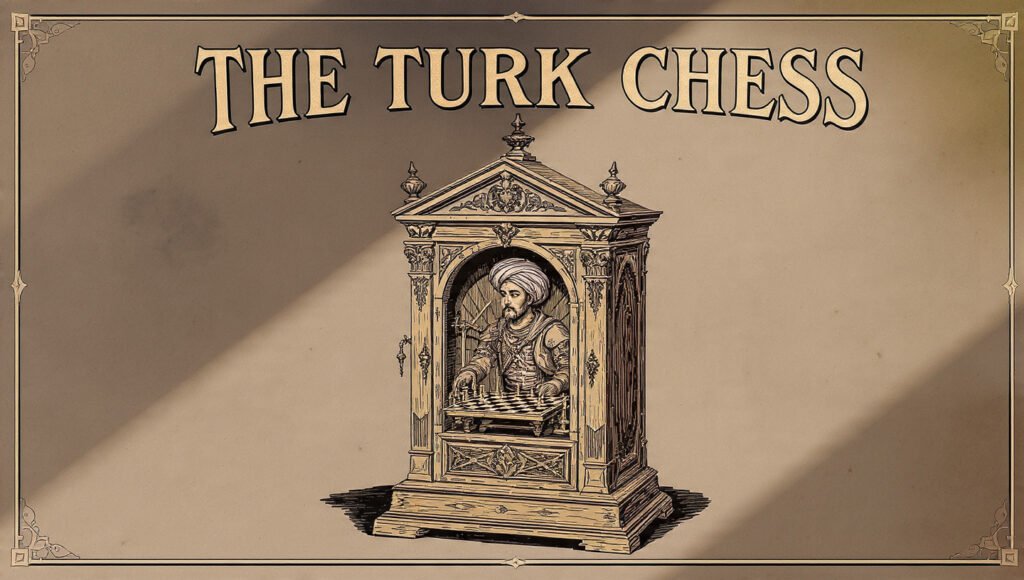
The Turk Chess stands as one of history’s most intriguing mechanical marvels—a chess-playing automaton that captivated audiences across Europe and America for nearly a century. This remarkable device blended engineering ingenuity, theatrical presentation, and the timeless appeal of the game of chess into something truly unforgettable. The story of The Turk is not just about a machine; it’s about human ambition, deception, and our eternal fascination with artificial intelligence long before the modern computer age.
The Origins of The Turk Chess Automaton
The Turk Chess machine was created in 1770 by Wolfgang von Kempelen, a Hungarian inventor and engineer who sought to impress the Austro-Hungarian Empire’s Empress, Maria Theresa. The automaton emerged during an era when mechanical innovations were celebrated as wonders of the age, and creating a machine that could play chess—one of humanity’s most intellectually demanding games—seemed like the ultimate achievement.
Kempelen’s creation featured a life-sized figure dressed in Turkish clothing, hence the name “The Turk Chess.” The figure sat behind a large wooden cabinet containing an intricate system of gears, levers, and mechanical components. On the surface, it appeared to be a purely mechanical chess player, a genuine feat of engineering that could challenge and defeat human opponents in the game of chess. The presentation was theatrical and mysterious, with the inventor often demonstrating the Turk Chess to various royal courts and audiences across Europe.
How The Turk Chess Actually Worked
The mechanics of The fascinated spectators for generations. The machine featured a chessboard, and the automaton’s arm could move pieces with surprising dexterity. Observers marveled at how the Turk Chess appeared to think through moves, pause before acting, and even demonstrate something resembling chess strategy. The wooden cabinet beneath contained visible mechanisms that whirred and clicked, seemingly controlling the automaton’s movements.
However, the true secret of The Turk Chess’s remarkable skill lay not in pure mechanics alone. Hidden within the cabinet was a compartment just large enough for a human operator—typically a skilled chess player who could manipulate the machine’s movements through an ingenious system of magnets and mechanical linkages. This operator could see the chessboard through a specially designed peephole and controlled the arm movements, effectively playing chess through the machine.
The brilliance of The Turk Chess’s design was that the mechanical components created enough complexity and distraction to prevent casual observers from discovering the human operator. The chess-playing machine became a masterpiece of deception, combining legitimate engineering with clever illusion.
The Chess Legacy of The Turk
Throughout its operational lifetime, it demonstrated exceptional skill at the game of chess. The machine played against numerous notable opponents, including politicians, military leaders, and even Benjamin Franklin during a tour of America. The Turk Chess’s record at chess was remarkably strong, with relatively few documented losses. This success only deepened the mystery and the machine’s legendary status.
Different operators brought different playing styles to The Turk Chess. Some favored aggressive tactics, while others displayed a more cautious approach to the game of chess. This variation in performance might have been one of the clues to perceptive observers that something more than pure mechanism was at work, yet the secret was well-kept for many years.
The Legendary Matches and Public Fascination
The Turk Chess captured public imagination like few technological innovations of its era. Exhibitions of The Turk Chess chess performances became major events, drawing crowds who paid to witness the marvel. The machine traveled extensively, visiting major European cities and eventually crossing the Atlantic to demonstrate its chess prowess in America.
One of the most famous matches involving The Turk Chess was against a human opponent in a public setting, where spectators gathered to witness what they believed to be a machine defeating a human at chess. The stakes were often high, both in terms of money wagered and prestige. Wealthy patrons would challenge The Turk Chess, desperate to prove they could outplay the mechanical marvel in chess.
The mystique of The Turk Chess grew with each successful match. Newspapers published accounts of its victories, and the machine became the subject of popular speculation. Could machines truly think? Was artificial intelligence possible? These questions, posed centuries before modern computers, emerged from widespread fascination with The Turk Chess.
The Engineering and Innovation Behind The Chess Machine
From a purely mechanical standpoint, The Turk Chess represented significant engineering achievement. The system of levers and pulleys that moved the automaton’s arm required precise calibration. The mechanical chess player’s ability to move pieces swiftly and accurately demonstrated sophisticated understanding of mechanics and physics.
The chess-playing machine incorporated innovations in automation that would influence later developments in mechanical engineering. Even though the secret of The Turk Chess involved human operation, the mechanical systems that translated human intention into physical movement were genuinely innovative. The machine that played chess showed how complex tasks could be mechanized, a concept that would prove foundational to the industrial age.
Unmasking the Mystery: Revealing the Secret of The Turk
The secret of The Turk Chess remained remarkably secure during its operational years, though skeptics frequently questioned whether the automaton could genuinely operate without human assistance. As the machine aged and passed through different owners, the truth gradually emerged through various sources—notably through documentation and the accounts of those who had operated The Turk Chess from within.
By the early 19th century, it became increasingly clear that The Turk Chess, while mechanically impressive, relied upon a human player hidden in its cabinet. The revelation didn’t diminish the machine’s historical significance. Rather, it highlighted the cleverness of both its engineering and its deception. The Turk Chess had been a masterpiece of illusion, proving that sometimes perception and reality could be artfully separated.
The Legacy and Cultural Impact of The Turk Chess
The Turk Chess profoundly influenced how people thought about machines, intelligence, and the possibilities of technology. The machine that played chess sparked philosophical debates that continued long after its secret was revealed. Could machines be programmed to think? What was the nature of intelligence? These questions, central to modern discussions about artificial intelligence, found their earliest widespread expression through fascination .
The story of also established a template for technological deception and the power of presentation. The machine demonstrated that audiences desperately wanted to believe in mechanical marvels, even when evidence suggested otherwise. This human desire for wonder and innovation has persisted, finding modern expression in how we discuss AI and cutting-edge technology.
The Turk Chess Today: Historical Significance and Replicas
Today, The Turk Chess remains a celebrated artifact of scientific history. Replicas and reconstructions of the famous automaton exist in various museums around the world, allowing new generations to marvel at the ingenious device. The Turk Chess has been the subject of numerous books, documentaries, and academic studies exploring both its mechanical design and its cultural significance.
The machine that once amazed audiences with its chess prowess now serves as a reminder of human creativity, engineering skill, and our timeless fascination with the boundary between human and machine intelligence. The Turk Chess represents a pivotal moment when technology and showmanship merged to create something greater than the sum of their parts.