
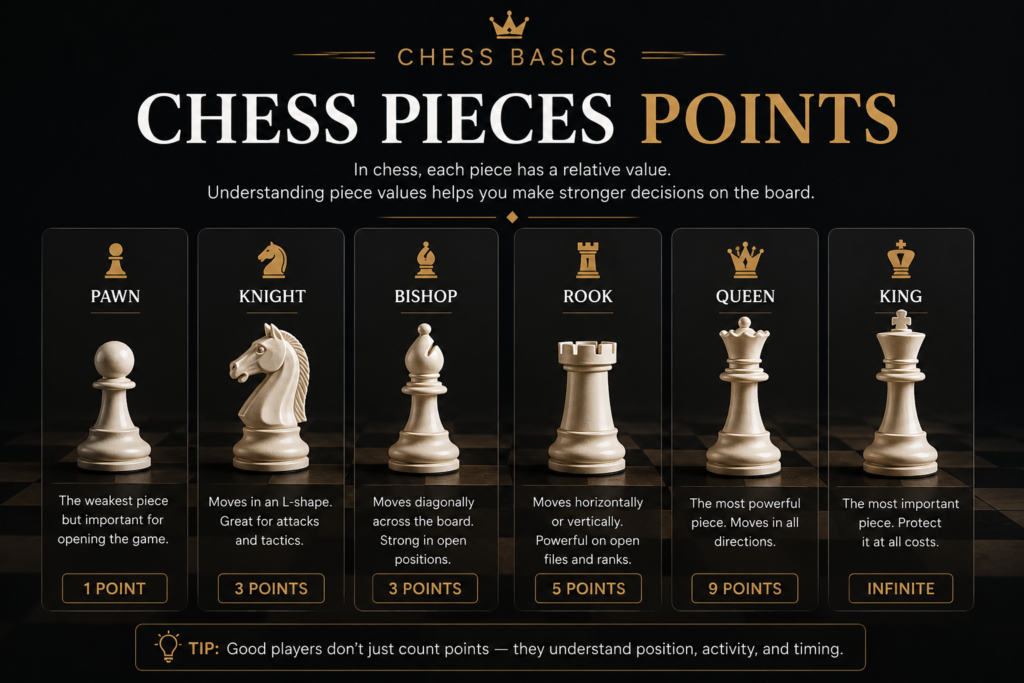
Chess is a game of tremendous complexity, yet its foundation rests on surprisingly simple numerical values. The concept of chess pieces points forms the backbone of chess evaluation, helping players assess positions, make strategic decisions, and understand the material balance at any given moment. By mastering the point values associated with each piece, players gain insight into fundamental principles that separate casual players from serious competitors. Numerical Foundation understanding of chess pieces points isn’t merely academic—it’s a practical tool that enables players to calculate whether trades are favorable and to develop sound strategic plans throughout the game.
The Foundation: Understanding Piece Values
At the heart of chess theory lies a straightforward but profound concept: each piece has an assigned point value. This numerical system provides chess players with a universal language for discussing the game’s material aspects. The traditional valuation system has been refined over centuries and remains remarkably consistent across all levels of chess play.
The pawn, being the smallest and least powerful piece, serves as the baseline unit and is valued at one point. Every other piece’s value is calculated relative to the pawn, creating a hierarchical system that reflects practical chess reality. This foundational measurement—chess pieces points—allows players to make quick calculations about whether exchanges benefit their position.
The Pawn: The Foundation Unit
Pawns, valued at one point each, represent the most abundant pieces on the board. While individually weak, pawns collectively form the structure upon which chess positions are built. Eight pawns line the board at the start, and their movement creates the pawn structure that defines positional play.
Understanding pawns as one-point units helps players grasp fundamental strategic concepts. A pawn is worth sacrificing to eliminate opposing pieces worth more, but losing pawns without compensation weakens one’s position. Advanced pawns gain disproportionate strength—a pawn on the seventh rank (one square from promotion) becomes worth considerably more than a pawn on its starting square.
The concept of pawn points teaches an essential lesson: not all pieces have identical value in every position. Context matters tremendously in chess. A pawn on the seventh rank might be worth three or four points in practical terms, even though its nominal value remains one point.
The Knight: Three Points of Power
Knights, valued at approximately three points, represent the first significant leap in piece value. Each player begins with two knights, positioned between pawns and bishops on the back rank. The knight’s unique movement pattern—traveling in an L-shape—gives it characteristics that distinguish it from all other pieces.
Knights are worth three points because they control approximately eight squares from a central position, providing significant tactical possibilities. However, knights suffer from a critical limitation: they require multiple moves to travel across the board. In open positions where quick piece mobility matters, knights are sometimes less effective than bishops of equal point value.
The three-point valuation reflects practical chess experience. Players willingly trade knights for three pawns because the knight’s ability to control squares and create tactical threats justifies this exchange. However, trading a knight for two pawns usually disadvantages the player surrendering the knight.
The Bishop: Three Points of Diagonal Control
Bishops, also valued at three points like knights, control chess squares along diagonal lines. Each player begins with two bishops—one traveling on light squares and one on dark squares throughout the entire game. This piece-square restriction is significant; a bishop on light squares can never reach dark squares, limiting its scope.
The three-point valuation reflects the bishop’s practical strength, though many players find bishops slightly preferable to knights in most positions. Bishops excel in open positions with long diagonals available for control. The pair of bishops—one light-squared and one dark-squared—becomes particularly powerful because together they control both colored squares.
Understanding chess pieces points requires recognizing that in certain positions, bishops outweigh knights considerably, despite sharing the same nominal three-point value. A bishop near the board’s edge or locked behind pawns becomes nearly worthless, while a bishop on an open diagonal becomes an exceptionally powerful piece.
The Rook: Five Points of Lateral Strength
Rooks, valued at five points, represent a significant jump in material value. Each player begins with two rooks, positioned in the board’s corners. Rooks control both horizontal and vertical lines, making them tremendously powerful pieces, especially in endgames.
The five-point valuation reflects the rook’s practical dominance. A rook is worth a knight plus two pawns (3+2=5), and most players would readily make this trade. Two rooks, valued at ten points, outweigh a queen (nine points) in many positions, particularly in endgames where rook activity determines victory.
Rooks become increasingly powerful as the game progresses. In the opening, with the board crowded with pieces, rooks often sit passively. However, as pieces get exchanged and the board opens, rooks’ true power emerges. Two active rooks can overpower passive pieces that are worth more on paper.
The Queen: Nine Points of Ultimate Power
The queen, valued at nine points, represents the single most powerful piece on the board. Combining the movement capabilities of both rooks and bishops, queens control tremendously more squares than any other piece. Each player begins with one queen, and losing it usually means losing the game—unless spectacular compensation exists.
The nine-point valuation reflects practical chess reality. A queen is worth significantly more than a rook plus a bishop (5+3=8), though close in value. Losing a queen without compensation is catastrophic; even winning considerable material in return rarely compensates for surrendering the board’s most powerful piece.
Numerical Foundation Queens are most effective in the middlegame, where their ability to attack multiple pieces and create threats shines. In endgames with few pieces, queens remain powerful but sometimes become less dominant, particularly against rooks supported by pawns.
The King: Priceless Beyond Points
The king, while not assigned a point value, is the game’s most important piece. Losing the king means losing the game immediately through checkmate. This pricelessness demonstrates that chess pieces points don’t capture the complete picture of chess values.
In the opening and middlegame, the king’s safety justifies defensive measures worth significant material. Sacrificing material to achieve checkmate—a concept that contradicts material balance—occurs regularly in chess. These situations remind players that point values, while useful, represent approximations rather than absolute truths.
In the endgame, the king transforms into a powerful attacking and defending piece, sometimes worth more than a pawn in practical terms. A king skillfully positioned near opponent pawns can prevent advancement or win material that a distant king cannot.
Material Balance and Position Evaluation
Understanding chess pieces points enables players to quickly assess position evaluation. If you have a rook and two pawns (5+2=7) and your opponent has two bishops and three pawns (3+3+3=9), material is roughly equal, though your opponent holds a slight material advantage.
However, material balance tells only part of the story. A position might be materially equal yet one side might be winning because of superior piece placement, pawn structure, or king safety. The best players recognize that material values provide frameworks for assessment, not definitive judgments.
Position evaluation involves synthesizing multiple factors: material balance, piece activity, pawn structure, king safety, and tempo. A position down material but with active pieces, strong pawn structure, and opponent king safety might be objectively winning despite the material deficit.
Trading and Exchange Considerations
Sound players use point values to make trading decisions. Trading your knight for your opponent’s bishop both lose three points—neutral exchanges. However, trading your queen (nine points) for opponent’s queen (nine points) changes the position’s nature, sometimes favoring one side based on remaining pieces and position characteristics.
Material trades affect position complexity. Eliminating pieces often favors the side with superior endgame technique. Conversely, maintaining piece complexity sometimes helps materially disadvantaged players create practical complications.
Numerical Foundation Expert players understand exchange nuances beyond point values. Trading a well-placed bishop for an opponent’s poorly-placed knight might be undesirable despite mathematical similarity (3 points each). Position-specific factors often supersede nominal point values in determining exchange wisdom.
Sacrifice Concepts and Point Defiance
Chess frequently features sacrifices—intentional material loss for strategic compensation. A player might sacrifice a pawn (1 point) or even a piece (3+ points) to create attacking chances, improve piece placement, or achieve positional advantages that numerical values can’t capture.
The most dramatic sacrifices defy chess pieces points logic entirely. Sacrificing a queen to achieve checkmate demonstrates that material values are means to achieving checkmate, not ultimate goals. Understanding when sacrifices are sound requires experience and deep positional insight beyond what numerical values provide.
Modern Perspectives: Computer Evaluations
Contemporary chess engines evaluate positions using sophisticated mathematical systems far more complex than simple piece counting. These engines recognize that pieces’ values fluctuate based on position characteristics, piece activity, and strategic factors.
Computer analysis has reinforced that piece values are approximations useful for human players but insufficient for complete position understanding. Engines might evaluate a position where material is roughly equal but one side is winning by several pawns (several points in computer evaluation terms) due to superior piece activity, pawn structure, or attacking possibilities.
Practical Application for Improving Players
For chess students, understanding piece values builds the foundation for sound decision-making. Beginners learn basic point values to avoid hanging pieces or making terrible trades. Intermediate players use these values as reference points while recognizing position-specific factors.
Advanced players internalize chess pieces points so completely that they operate intuitively, rarely needing conscious calculation. They’ve absorbed how pieces interact, when sacrifices are sound, and how position characteristics modify piece values.
For aspiring competitive players, piece values should be treated as flexible frameworks rather than rigid formulas . The best chess combines numerical assessment with positional judgment, strategic vision, and tactical acuteness.
The Enduring Importance of Point Values
Despite chess’s tremendous complexity, piece point values remain remarkably relevant centuries after their development. This persistence demonstrates that fundamental chess truths endure through evolving understanding and technology.
Players from beginners to world champions use piece values daily in their decision-making processes. Whether consciously calculating whether a trade is favorable or intuitively sensing when material advantage suffices for victory, point values underpin chess reasoning.
Numerical Foundation Understanding chess pieces points represents investing in chess literacy—learning the game’s foundational language that enables deeper strategic and tactical comprehension. This fundamental knowledge separates casual players from those seriously committed to improving their chess understanding and competitive results.
Pingback: Queens Gambit Chess Play: A Comprehensive Guide to One of Chess's Most Celebrated Openings - Chess Next Move - Best next move calculator