
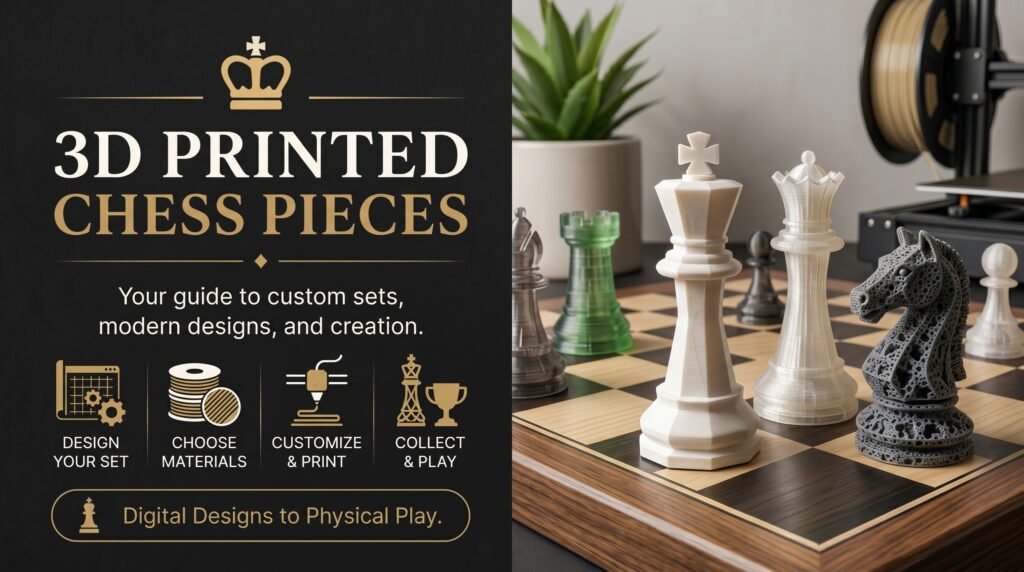
Chess has been around for over 1,500 years, and while the rules have stayed largely the same, the way people make and collect chess pieces has changed quite a bit. One of the most interesting shifts in recent years is the rise of 3D printed chess pieces. Whether someone is a hobbyist looking for a weekend project, a chess enthusiast wanting a unique set, or a designer with a creative vision, 3D printing offers a surprisingly accessible and satisfying way to bring a custom chess set to life.
This guide covers everything worth knowing about 3D printed chess pieces, from choosing materials to finishing touches, and why so many people are turning to their printers instead of buying off the shelf.
Why People Are Choosing 3D Printed Chess Pieces
There is something genuinely appealing about owning a chess set that no one else has. Mass-produced chess sets, while affordable and functional, tend to look identical. A 3D printed chess set, on the other hand, can reflect a person’s personality, interests, or aesthetic preferences in ways that store-bought versions simply cannot.
Beyond personalization, cost is another big factor. A high-quality handcrafted wooden or metal chess set can run into hundreds of dollars. A decent 3D printer, paired with a spool of filament, can produce a complete chess set for a fraction of that price. For families, classrooms, or chess clubs that need multiple sets, this cost difference adds up quickly.
There is also the satisfaction of the process itself. Many people who get into 3D printing enjoy the learning curve, the tinkering, and the moment when a physical object that only existed as a digital file becomes something you can actually hold and move across a board.
Materials That Work Well for 3D Printed Chess Pieces
Choosing the right material is one of the most important decisions when printing chess pieces. The two most common options are FDM (Fused Deposition Modeling) filament and resin, and both have their strengths.
PLA Filament
PLA (Polylactic Acid) is the most widely used material for beginner and intermediate 3D printing projects, and it works well for chess pieces. It is easy to print with, comes in a wide range of colors, and produces decent detail for standard-sized pieces. The main limitation is that PLA can struggle with very fine details, such as thin crowns on kings or delicate knight mane designs. For classic Staunton-style pieces, though, PLA delivers solid results.
PETG and ABS
PETG is slightly more durable than PLA and holds up better under heat, making it a good choice for pieces that will be handled frequently. ABS is another option for players who want tougher pieces, though it requires a more controlled printing environment to avoid warping.
Resin
For anyone who wants chess pieces with sharp, fine detail, resin printing is the better route. Resin 3D printed chess pieces can capture incredibly intricate designs, from elaborate fantasy themes to historically accurate medieval figures. The trade-off is that resin printing requires more safety precautions, including gloves and ventilation, and the post-processing steps (washing and curing) add extra time. Still, the visual results are noticeably superior for complex designs.
Finding or Designing 3D Models for Chess Pieces
One of the most exciting parts of making 3D printed chess pieces is the sheer volume of designs available online. Platforms like Thingiverse, Printables, and MyMiniFactory host thousands of free and paid chess piece models, ranging from simple abstract sets to elaborate themed collections.
Popular themes people look for include:
- Fantasy and gaming themes (dragons, wizards, orcs, and mythical creatures standing in for traditional pieces)
- Historical themes (Roman, Viking, Egyptian, or medieval-inspired sets)
- Pop culture themes (space-themed sets, steampunk designs, architectural chess pieces)
- Minimalist and modern designs (geometric, abstract, or contemporary interpretations of classic forms)
For those who want to create their own models, programs like Blender, TinkerCAD, and Fusion 360 are commonly used. TinkerCAD is particularly beginner-friendly and allows someone with no prior design experience to create basic chess piece shapes within a few hours of learning. Blender offers far more creative freedom but comes with a steeper learning curve.
When designing from scratch, it helps to follow standard Staunton size guidelines if the pieces will be used with a regulation board. The king is typically the tallest piece, standing around 95mm to 105mm for a tournament-style set. All other pieces scale proportionally from there.
Printing Tips for Clean, Quality Results
Getting good results from 3D printed chess pieces is largely about patience and settings. A few practical tips go a long way.
Print Orientation Matters
Many chess pieces, especially pawns and bishops, print better standing upright rather than on their side. Upright printing reduces the need for support material and keeps the surface finish cleaner. However, very tall pieces like kings may benefit from being printed at a slight angle to reduce stringing or wobble at higher layers.
Layer Height and Resolution
A layer height of 0.1mm to 0.15mm gives noticeably better surface quality than the standard 0.2mm setting. This matters most on rounded shapes and tapered tops, which are common in chess piece designs. The print will take longer, but the smoother finish is worth it for a display-quality set.
Supports and Overhangs
Complex designs, particularly fantasy-themed 3D printed chess pieces with outstretched limbs or dramatic poses, often require support structures. Tree supports or custom support painting (available in slicers like Chitubox or Lychee for resin, and PrusaSlicer or Cura for FDM) can make support removal much cleaner.
Scaling for the Board
Before printing a full set, it is worth printing one piece at the intended scale and placing it on the actual board. The base diameter of each piece should fit comfortably within the squares without overlapping. A general rule is that the king’s base diameter should be roughly 78% of the square size on the board.
Customizing Chess Pieces Beyond the Print
One area where 3D printed chess sets truly shine is post-print customization. Unlike a purchased set, a printed set can be modified, repainted, and finished in dozens of ways.
Painting and Color
Many people paint their 3D printed chess pieces with acrylic paints to achieve a two-tone look (typically black and white, or dark and light), or to bring out the details on themed sets. A base coat of primer helps paint adhere better and gives a more uniform finish. After painting, a clear matte or gloss varnish protects the surface and gives the pieces a more polished appearance.
Weighting the Pieces
One common criticism of 3D printed chess pieces is that they feel light compared to wooden or metal sets. A simple fix is to drill a small hole in the base of each piece and insert a steel nut or a small weight before sealing it with epoxy. This small modification gives pieces a noticeably more satisfying feel when moved across the board.
Felt Bases
Attaching small felt pads to the bottom of each piece protects the board from scratches and adds a professional touch. Pre-cut felt circles in the right diameter can be found cheaply and glued on with contact cement or a dab of super glue.
Are 3D Printed Chess Pieces Actually Good for Playing?
This is a fair question, and the honest answer is: it depends on the quality of the print and the design chosen.
For casual home play, 3D printed chess pieces work perfectly well. They are functional, fun to play with, and often start interesting conversations. For competitive or club play, tournament regulations typically require Staunton-style pieces within specific size and weight ranges, which a well-calibrated printer can absolutely produce.
Where 3D printed pieces sometimes fall short is durability under heavy, repeated use. PLA pieces in particular can wear at the base over time if dragged frequently across a hard board. Using PETG or resin for a playing set, rather than a display set, extends the lifespan considerably.
For display purposes, such as themed shelf pieces or collector sets, 3D printed chess pieces are hard to beat in terms of uniqueness and visual impact. A resin-printed fantasy chess set with hand-painted detail can look genuinely museum-worthy.
A Hobby That Combines Two Passions
For people who already enjoy chess and have access to a 3D printer, making a custom set is one of the most rewarding projects to take on. It sits at the intersection of strategy, design, and craftsmanship, and the end result is something both playable and personal.
Even for someone new to 3D printing, a chess set is a surprisingly good beginner project. The pieces are self-contained, there is room for error (a slightly imperfect pawn is still a pawn), and the process of printing all 32 pieces teaches a lot about printer settings, material behavior, and finishing techniques.
The community around 3D printed chess pieces is also active and generous. Dozens of free model collections exist specifically for chess enthusiasts, and online forums and groups regularly share tips, settings, and design files.
Final Thoughts
3D printed chess pieces represent a genuinely interesting corner of both the maker community and the chess world. They make custom, one-of-a-kind sets accessible to almost anyone with a printer and a bit of patience. Whether the goal is a simple two-color set for family game nights or an elaborate themed collection to display on a shelf, the tools, materials, and designs available today make it more achievable than ever.
For anyone sitting on the fence, the best advice is simple: pick a design, load the filament, and start printing. The result might surprise them.
Pingback: Chess Board Drawing: A Step-by-Step Guide for Beginners and Art Enthusiasts - Chess Next Move - Best next move calculator