
How to castle in chess .Chess is one of those games that rewards patience, strategy, and a deep understanding of its rules. Among all the moves available on the board, few are as powerful — or as misunderstood — as castling. For anyone learning how to castle in chess, this guide breaks down everything in a clear, friendly, and easy-to-follow way. Whether someone is a beginner stepping onto the board for the first time or an intermediate player looking to sharpen their game, this article covers it all.
What Is Castling in Chess?
Castling is a special move in chess that involves two pieces at once — the king and a rook. It is the only move in the entire game where a player gets to move two of their own pieces in a single turn. The purpose of castling goes beyond just following the rules; it serves a deeply strategic function.
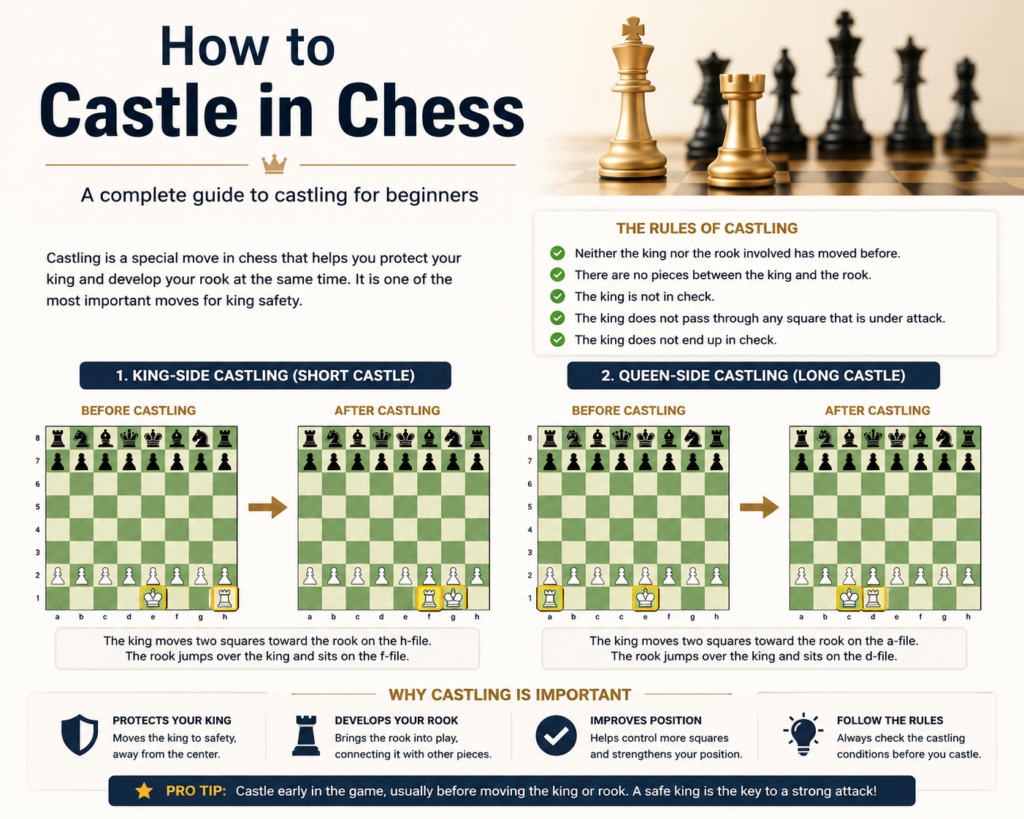
When a player castles, the king moves two squares toward one of the rooks, and that rook jumps over the king to land on the square right next to it. This move can happen on either side of the board — the kingside or the queenside — and each option comes with its own set of advantages.
Understanding how to castle in chess is one of the first things any serious player should add to their skill set because it does two important things simultaneously: it tucks the king away into a safer position and activates the rook, bringing it into the game from its starting corner.
Why Castling Matters: The Strategic Purpose
Before diving into the mechanics, it helps to understand why castling is considered so essential.
King Safety
The center of the board is a battlefield. Pieces attack, trade, and dominate the central squares throughout most of the game. Leaving the king in the middle during this chaos is a recipe for disaster. Castling moves the king to the side of the board, tucked behind a wall of pawns, where it becomes much harder for the opponent to launch a direct attack .how to castle in chess
Rook Activation
Rooks are powerful long-range pieces, but they start the game locked in the corners behind other pieces. Castling is one of the fastest ways to connect the rooks and bring them toward the center or open files, where they can truly shine.
The Two Types of Castling
There are two ways to castle in chess, and every player should know the difference.
Kingside Castling (Short Castling)
Kingside castling is often called “short castling” because the king travels a shorter distance. In this variation:
- The king moves two squares to the right (for White) toward the h-file rook.
- The rook on h1 (for White) jumps over the king and lands on f1.
- For Black, the king moves two squares to the left toward the h8 rook, and the rook lands on f8.
Kingside castling is generally quicker to set up because there are only two pieces — a knight and a bishop — standing between the king and the kingside rook. Many players prefer this option because it gets the king to safety faster.
Queenside Castling (Long Castling)
Queenside castling, also called “long castling,” involves more ground to cover:
- The king moves two squares to the left (for White) toward the a-file rook.
- The rook on a1 moves to d1.
- For Black, the same concept applies on the opposite side.
Because three pieces stand between the king and the queenside rook — a queen, a bishop, and a knight — it takes more preparation to castle queenside. However, this option is often associated with aggressive gameplay, as the rook lands on a more central square (d1 for White), giving it immediate influence on the board.
how to castle in chess
How to Castle in Chess: Step-by-Step
Now comes the practical part. Here is exactly how to castle in chess, broken down into simple steps:
- Clear the path. Move all pieces between the king and the chosen rook off those squares. No piece — friendly or otherwise — can stand between them.
- Move the king two squares toward the rook. In an over-the-board game, the player should always touch and move the king first before touching the rook. This avoids any ambiguity about whether a rook move was intended instead.
- Move the rook to the square immediately on the other side of the king. The rook “hops” over the king.
That’s the physical action of castling. Simple, right? The tricky part lies in knowing when a player is legally allowed to castle — because the rules come with several important conditions.
The Rules: When Is Castling Allowed?
Learning how to castle in chess also means understanding the legal requirements .how to castle in chess There are specific conditions that must all be met before castling is permitted. The king and rook both have to be making their first move.
Both the king and the rook involved in the castling move must be on their original starting squares and must not have moved at any point during the game. Even if they return to their starting squares after moving, castling is no longer allowed. This rule encourages players to plan ahead and resist the temptation to shuffle the king or rooks unnecessarily early in the game.
The King Cannot Be in Check
A player cannot castle while their king is in check. If the opponent’s piece is attacking the king at that moment, the player must deal with the check by another means — blocking, capturing the attacker, or moving the king somewhere else.
The King Cannot Pass Through Check
The squares the king travels through during castling must not be under attack by any of the opponent’s pieces. For kingside castling, the king passes through f1 (for White). If that square is attacked, kingside castling is illegal at that moment. For queenside castling, the king passes through d1.
The King Cannot Land in Check
The square where the king ends up after castling must also be safe. The king cannot castle into a position where it would be in check.
how to castle in chess
No Pieces Between King and Rook
The path between the king and rook must be completely clear. Even if every other condition is met, a single piece blocking the way makes castling impossible until the path is opened.
Common Mistakes Beginners Make With Castling
Even after understanding the rules, players often make errors when it comes to castling. Here are some of the most frequent mistakes and how to avoid them.
Waiting Too Long
One of the biggest mistakes is delaying castling for too long. Waiting until the middlegame is in full swing, with pieces actively attacking, can make castling impossible or even dangerous. Getting the king to safety early — usually within the first ten moves — is a habit worth developing.
Castling Into an Attack
Castling is meant to improve king safety, but that is not always the result. If the opponent has already moved pawns toward the kingside, castling kingside could walk the king right into a storm. Players need to assess which side of the board is safer before choosing where to castle.
Forgetting the Rules Mid-Game
It happens more often than one might expect — a player assumes they can still castle, forgetting that the king or rook moved earlier in the game. Keeping track of whether castling rights are still intact is an important part of managing a chess game.
Tips for Using Castling Effectively
Knowing how to castle in chess is one thing; using it effectively is another. Here are some practical tips that can elevate the way castling fits into overall game strategy.
Castle Early in the Opening
Most experienced players aim to castle within the first 10 moves of a game. The opening phase is the ideal time to develop pieces, control the center, and get the king safe. Delaying castling too long leaves the king vulnerable during piece exchanges.
Coordinate the Castle With a Plan
Castling should never be a reflexive move made just because it feels right. The side a player castles on should align with their broader plan. If launching a queenside attack, kingside castling might make more sense to keep the king far from the action.
Keep Pawns in Front of the King Intact
After castling, your king hides behind its pawn shield. Advancing them too quickly or trading them away can expose the king to attacks. Unless there is a very specific reason to push those pawns, keeping them in place is usually the safer choice.
Watch the Opponent’s Castling Position Too
Chess is a two-player game. While thinking about where to put the king, it also pays to watch where the opponent castles. Knowing which side their king is on helps shape an attacking plan for the rest of the game.
Can a Player Choose Not to Castle?
Absolutely. Castling is not mandatory. There are games — especially at advanced levels — where players deliberately avoid castling to keep the king in a more central position for the endgame, where a centralized king is often stronger. Some openings even feature “artificial castling,” where the king walks to a corner-like square manually over several moves.
That said, for most players at most skill levels, castling remains one of the best and most reliable moves in the early and middle phases of a chess game.
Final Thoughts
Castling is one of chess’s most elegant mechanics. In a single move, it addresses two of the game’s most fundamental concerns — king safety and piece activity. Anyone who takes the time to truly learn how to castle in chess, including the rules, the variations, and the strategic timing, will immediately notice an improvement in their overall game.
For beginners, the advice is simple: clear the path, castle early, and tuck the king behind those pawns. For more experienced players how to castle in chess , the nuance lies in when and where to castle, and how that choice ties into the broader battle unfolding across the board.
Chess rewards those who think a few moves ahead, and castling is a perfect example of a move that pays dividends well beyond the moment it’s played.
Pingback: The Turk Chess: History's Most Captivating Mechanical Chess Machine - Chess Next Move - Best next move calculator