
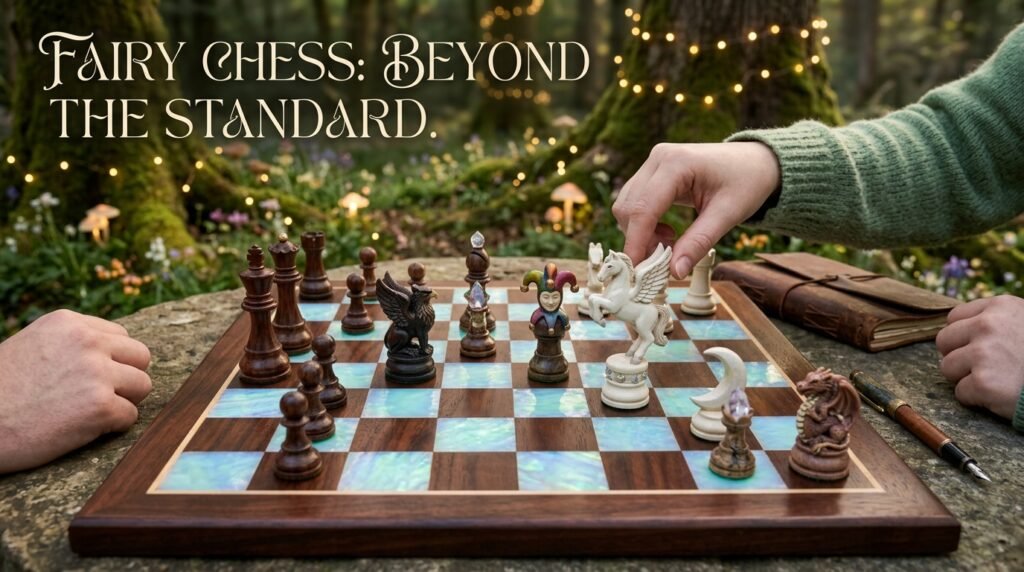
Chess has been captivating minds for centuries, but for those who feel the traditional 64-square board has grown a little familiar, there exists a wonderfully imaginative alternative — fairy chess. This creative branch of chess introduces unconventional pieces, modified rules, and entirely new board configurations, transforming a classic game into something fresh, surprising, and endlessly inventive. Whether someone is a lifelong chess enthusiast or just beginning to explore the game, fairy chess opens a door to a universe where the rules are beautifully bendable.
What Is Fairy Chess?
Fairy chess is a broad term used to describe any variation of chess that departs from the standard rules of the game. It encompasses a wide range of modifications — from the introduction of new piece types and expanded board dimensions to entirely alternate win conditions and movement mechanics.
The term was first popularized by Henry Dudeney and later extensively developed by T.R. Dawson in the early 20th century. Dawson, often called the “father of fairy chess,” devoted much of his life to composing chess problems that featured non-standard pieces and rules. His work laid the groundwork for a rich tradition of creative chess problem composition that continues to this day.
Unlike orthodox chess, fairy chess does not follow a single rigid ruleset. Instead, it acts more like a creative philosophy — a permission slip for players and puzzle composers to reimagine the game from the ground up. Some versions of fairy chess are played competitively, while others exist purely as intellectual puzzles composed for the enjoyment of solvers.
The Origins and History of Fairy Chess
The history of fairy chess stretches back further than many people realize. Variants of chess with non-standard pieces or boards appeared in various cultures long before the term “fairy chess” was coined. Ancient Indian, Persian, and Chinese chess traditions all featured pieces and rules that diverged significantly from what is recognized as standard chess today.
In Europe, interest in chess variants grew during the 19th century alongside the broader popularization of chess as a competitive game. Puzzle composers began experimenting with hypothetical pieces — asking questions like “what if a piece could move like a bishop and a knight at the same time?” — and the results were intellectually electrifying.
By the early 20th century, T.R. Dawson had formalized much of the language and theory around fairy chess, publishing extensively in chess journals and compiling problems that showcased invented pieces with exotic movement rules. His contributions gave the field a vocabulary and a structure, helping it grow from a casual curiosity into a recognized area of chess study.
Today, fairy chess problems are published in specialized journals and online communities, with dedicated solvers and composers around the world contributing to the tradition. Organizations like the World Federation for Chess Composition (WFCC) oversee competitions that include fairy chess categories.
Fairy Chess Pieces: Beyond Kings and Pawns
One of the most exciting aspects of fairy chess is the extraordinary variety of pieces that composers and variant designers have invented. These pieces often have creative, mythologically inspired names and movement rules that challenge solvers to think in entirely new ways.
The Nightrider
One of the most famous fairy chess pieces is the Nightrider. Unlike a standard knight, which makes a single L-shaped leap, the Nightrider can continue making knight-like moves in the same direction repeatedly, essentially “riding” in a straight line of knight steps. This gives the Nightrider a dramatically extended range and creates fascinating tactical possibilities.
The Grasshopper
The Grasshopper is another beloved fairy piece. It moves along the same lines as a queen — horizontally, vertically, or diagonally — but it must jump over exactly one other piece to land on the square immediately beyond it. If there is no piece to hop over, or if the landing square is occupied by a friendly piece, the Grasshopper cannot move in that direction. This conditional movement makes it a deeply strategic piece that can become powerful or completely passive depending on the position.
The Amazon
The Amazon (also known as the Queen + Knight compound) combines the movement of both a queen and a knight. It is considered one of the most powerful pieces in fairy chess, capable of enormous reach and creative threats that standard pieces cannot replicate.
The Camel and Zebra
The Camel moves in a pattern similar to the knight but with a 1×3 leap instead of a 1×2 one. The Zebra takes this further with a 2×3 leap. Both pieces are classified as “leapers” — pieces that jump to fixed destinations regardless of what lies between. These leapers introduce colorbound properties and unique tactical textures that make for intellectually stimulating puzzles.
The Alfil and Dabbaba
Taken from historical chess variants, the Alfil leaps exactly two squares diagonally, while the Dabbaba leaps exactly two squares orthogonally. Both are permanently restricted to one-quarter of the board’s squares, which makes them fascinating pieces to work with in the confined environment of a problem composition.
Types of Fairy Chess Variants
Fairy chess is not a monolithic category — it branches into several distinct types, each with its own flavor and tradition.
Heterodox Chess Problems
These are compositions that use fairy pieces or rules to create interesting problems for solvers. The goal is not always checkmate; some problems ask solvers to achieve “helpmate” (where both sides cooperate to achieve a specific result), “selfmate” (where one side tries to force the other to deliver checkmate), or other unique objectives.
Cylindrical Chess
In Cylindrical Chess, the board is treated as though the left and right edges are connected, forming a cylinder. Pieces that reach one side of the board can “wrap around” to the other. This changes the geometry of the game significantly, as bishops and rooks gain new lines and pieces can threaten from unexpected directions.
Alice Chess
Alice Chess is played on two boards simultaneously. When a piece moves on one board, it transfers to the corresponding square on the second board. Pieces on one board cannot interact with those on the other, except through this transfer mechanic. The result is a beautifully disorienting variant that requires players to track two interwoven realities at once.
Circe Chess
In Circe Chess, captured pieces are reborn on their starting squares after being taken, as long as the square is unoccupied. This fundamentally changes the value of captures and the endgame dynamics, making it nearly impossible to reduce the opponent’s army through conventional attrition.
Atomic Chess
Atomic Chess introduces dramatic consequences for every capture: when a piece is taken, it “explodes,” destroying all pieces on the surrounding squares (except pawns). The resulting tactical chaos makes for a completely different style of play, rewarding aggressive and unexpected combinations.
Fairy Chess in Problem Composition
Perhaps the most celebrated application of fairy chess is in the art of problem composition. A fairy chess problem is like a miniature puzzle — a carefully arranged position that asks the solver to achieve a specific goal, often in a precise number of moves. The best problems are admired not just for their difficulty but for their elegance, economy of pieces, and surprising solutions.
Composers spend considerable time crafting problems that use fairy pieces to achieve effects impossible in orthodox chess. A well-constructed fairy chess problem can feel like a magic trick — the position appears quiet and unassuming, but the solution unfolds in a way that delights and astonishes the solver.
Solving and composing fairy chess problems is also an excellent way to sharpen pattern recognition, deepen strategic thinking, and cultivate an appreciation for the mathematical beauty hidden within chess.
Why Fairy Chess Matters
Some might wonder why one would venture beyond the depths of standard chess, which already contains more possible games than atoms in the observable universe. The answer lies in the human love of creativity and exploration.
Fairy chess is not merely a diversion for those bored with orthodox chess — it is a legitimate intellectual pursuit that has attracted some of the finest minds in chess history. It offers composers a canvas for artistic expression, solvers a playground for creative problem-solving, and players an entirely new competitive landscape.
Furthermore, fairy chess serves as a reminder that the rules of any game are ultimately a human invention. Changing those rules doesn’t diminish the game — it reveals just how rich and varied the underlying logical space truly is.
Getting Started with Fairy Chess
For anyone curious about exploring fairy chess, the good news is that the community is welcoming and resources are plentiful. Online platforms such as Problemiste, MatPlus, and various chess composition forums host thousands of fairy chess problems at all difficulty levels. Software like WinChloe and Popeye allows enthusiasts to compose and verify fairy chess problems with ease.
Starting with simpler fairy pieces like the Grasshopper or Nightrider and working through beginner-level helpmates is a great entry point. From there, solvers can gradually work their way into more complex territory, exploring the full spectrum of what fairy chess has to offer.
Conclusion
Fairy chess stands as one of the most imaginative corners of the chess world — a space where creativity, logic, and artistic expression intersect in delightful ways. From the elegant Grasshopper to the explosive drama of Atomic Chess, fairy chess invites everyone to look at the beloved 64-square board and ask, “what if?” The answer, as countless composers and solvers have discovered, is always worth exploring.