
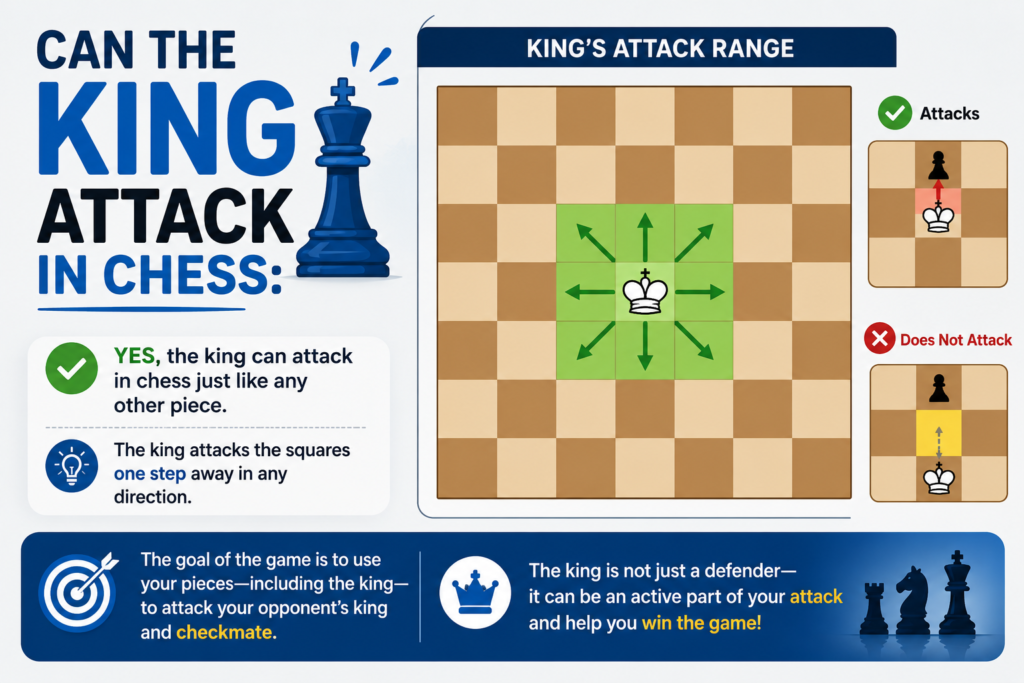
One of the most fundamental yet frequently misunderstood aspects of chess mechanics involves the king’s offensive capabilities. Players regularly wonder about the true extent of royal attacking power, asking: “Can the king attack in chess?” The answer, while straightforward, opens fascinating discussions about chess strategy, piece coordination, and endgame tactics. Understanding how the king attack functions reveals important dimensions of chess gameplay that significantly influence match outcomes.
Can the king attack in chess? represents a question every beginner encounters, and the answer deserves thorough exploration. Not only can the king attack in chess, but understanding king attacking capabilities separates competent players from those perpetually struggling with endgame positions and late-game strategy. This comprehensive guide examines every aspect of the king attack mechanism in chess, providing insights that enhance both beginner understanding and advanced competitive play.
Basic King Movement and Attacking Mechanics
How the King Moves
Understanding whether the king attack works requires first grasping fundamental king movement. The king in chess possesses remarkably limited mobility compared to other pieces—it moves exactly one square in any direction: horizontally, vertically, or diagonally. This restricted movement pattern distinguishes the king from all other pieces, fundamentally shaping how the king attack functions within competitive play.
The constraint of single-square movement means the king attack remains inherently limited in range. Unlike rooks that command entire rows and columns, or bishops that dominate diagonals, king attacks affect only immediately adjacent squares. This limitation makes understanding the king attack essential—players cannot rely on the king as a primary attacking force but must instead recognize specific strategic situations where the king attack becomes tactically relevant.
The King’s Attacking Capacity
Can the king attack in chess? absolutely—this piece possesses full attacking capabilities within its movement constraints. When the king occupies a square, it attacks every adjacent square simultaneously. The king attack functions automatically; players need not specifically declare attacking intentions. Simply placing the king adjacent to an opponent’s piece creates an attacking position threatening that piece’s capture.
The king attack operates identically to how the king defends squares. The piece simultaneously protects friendly pieces and threatens opponent pieces occupying adjacent squares. This dual function—simultaneous defense and offense—characterizes king attacking mechanics throughout gameplay. Understanding this simultaneous protection and threat distinguishes sophisticated players from novices misunderstanding king attacking dynamics.
Critical Limitation: The King Cannot Attack Defended Pieces
Here emerges one of the most important constraints governing the king attack in chess: the king absolutely cannot capture pieces protected by opponent pieces. This protection principle shapes every aspect of king attacking strategy. Even when the king stands adjacent to an opponent’s piece, capturing that piece requires the piece to be undefended.
This defensive requirement fundamentally alters how players evaluate the king attack opportunities. A seemingly available capture might prove impossible because the king attack cannot execute if the target piece enjoys protection. Sophisticated players constantly evaluate whether targeted pieces remain defended, assessing whether the king attack actually constitutes a legal move. This complexity makes understanding king attacking limitations essential for practical play.
The King in Attacking Positions: When Offensive Play Becomes Viable
King Activity in the Endgame
Can the king attack in chess effectively? The answer transforms dramatically as games progress toward endgames. While middlegame play typically restricts kings to defensive, central positions, endgame situations fundamentally transform the king attack into a genuinely powerful strategic element. As piece quantities diminish, the king emerges from protective positioning to become an active, aggressive piece.
In endgame scenarios involving kings, pawns, and perhaps one remaining minor piece, the king attack becomes critical for victory. The king’s ability to support pawn advancement, capture undefended pawns, and dominate opponent pieces becomes the game’s determining factor. Endgame specialists recognize that the king attack represents not a luxury but rather an essential component of endgame technique.
The transition from middlegame restraint to endgame aggression explains why understanding the king attack matters across all chess phases. Players who fail to recognize when the king attack should activate, remaining overly cautious with their kings, lose critical endgame advantages that proper king attacking play would secure.
Activating the King Strategically
Transitioning from king defense to the king attack requires understanding optimal timing and positioning. Premature king activation during middlegame creates dangerous exposure, allowing opponent pieces to attack the now-vulnerable king. Conversely, remaining unnecessarily passive during endgames squanders king attacking potential.
Experienced players gradually activate their kings, carefully moving them toward strategically important squares. This gradual activation differs from reckless king advancement. Strategic king attacking movement positions the king to support critical objectives—defending attacked pieces, supporting advancing pawns, or controlling escape squares around opponent pieces.
Tactical Patterns Involving King Attacks
King and Pawn Versus King Endgames
Few endgame scenarios demonstrate the king attack mechanics more clearly than king and pawn versus lone king situations. These deceptively simple positions involve profound complexity regarding the king attack, opposition, and precise square control. The active king must simultaneously prevent opponent advancement while supporting friendly pawn progression.
Understanding the king attack in these positions separates drawn games from victories. The stronger king placement, achieved through correct attacking and defending square choices, determines outcomes. Players demonstrating mastery of these positions exhibit sophisticated understanding of king attacking principles, having internalized how the king attack interacts with pawn movement constraints.
King and Minor Piece Attacking Patterns
When kings face minor pieces (knights or bishops) in complex positions, the king attack becomes a crucial tactical resource. While the king cannot defeat powerful minor pieces through simple attacking play, it can work alongside remaining pieces to execute attacks combining king attacking pressure with supplementary piece support.
Combinations involving the king attack alongside knight or bishop tactics create forcing sequences limiting opponent options. Recognizing these patterns allows players to generate king attacking opportunities others overlook. The seemingly passive piece becomes tactically vibrant when the king attack integrates with coordinated piece play.
Checkmate Patterns Requiring King Participation
Numerous checkmate patterns fundamentally depend on the king attack working in conjunction with other pieces. Back rank checkmates, smothered mates, and various forcing sequences require the king to attack or occupy critical squares completing checkmate patterns. Without understanding the king attack’s role in these combinations, players miss checkmate opportunities presenting themselves regularly.
The king’s ability to deliver checkmate—either through direct attack alongside other pieces or by controlling escape squares—demonstrates the king attack serving serious tactical purposes. Advanced players instinctively recognize positions where the king attack generates mating combinations.
King Attacks in Opening and Middlegame Play
Why Kings Remain Passive During Early Game
Early chess phases, through middlegame, typically restrict the king attack to theoretical possibilities rather than practical utility. Early game openings involve rapid piece development, central control, and establishing structural advantages. Prematurely activating the king through attacking moves exposes it to harassment from developed opponent pieces.
Strong opening play deliberately keeps the king passive and protected, typically castled into safety. King attacking adventures during openings inevitably prove disastrous, as the centralized king becomes target for coordinated opponent piece attacks. Understanding this passivity requirement helps players resist temptation toward premature king attacking activity.
Transitional Moments Toward King Activation
As middlegames progress toward endgames, players begin recognizing opportunities for graduated king attacking participation. These transitional moments require careful evaluation—determining whether piece exchanges have sufficiently reduced opponent attacking potential to justify king activation. Premature king attacking movement during these transitions still proves dangerous.
Sophisticated middlegame players recognize signals indicating safe moments for king attacking advancement. These signals include traded-away attacking pieces, distant opponent pieces unable to reach the king, or fortress positions where the king enjoys security despite active placement. Recognizing these king attacking opportunities distinguishes strong tactical players.
Advanced King Attacking Strategy
Centralization as Aggressive Strategy
Advanced players understand that king centralization—moving the king toward the board’s center—represents aggressive strategic positioning. While opening principles demand king safety, endgame principles require king activity and attacking placement on central squares. This strategic reversal confuses developing players unfamiliar with phase-specific king attacking principles.
Centralized kings dominate more squares, exert greater influence over piece placement, and create attacking threats against multiple targets simultaneously. The king’s central placement generates pressure without necessarily launching direct attacks, simply through the attacking squares it controls. Understanding this strategic attacking power transforms how players evaluate king placement.
Creating Multiple Threats Through King Placement
Sophisticated king attacking strategy involves positioning the king to create multiple simultaneous threats. Rather than pursuing direct captures, advanced players maneuver kings to positions where they simultaneously attack multiple pieces, force pieces into poor squares, or create attacking patterns limiting opponent options.
These multiple-threat king placements paralyze opponents, who cannot address every attacking threat simultaneously. The king’s modest individual attacking power amplifies dramatically when combined with positional pressure. Understanding how the king attack creates compound tactical pressure distinguishes strong players from weaker competitors.
King Infiltration and Winning Positions
King infiltration—advancing the king deep into opponent territory—often determines endgame winners. Infiltrating kings create immediate tactical threats while supporting remaining pieces’ attacking operations. The combination of direct king attacks with supporting piece pressure frequently overwhelms defensive attempts.
Players who understand king infiltration attacking strategy recognize when enemy defenses have weakened sufficiently to justify aggressive king advancement. Conversely, defenders must recognize danger signals indicating attacking king infiltration and take preventative measures before the king reaches dominant positions.
Defensive Aspects of Understanding King Attacks
Protecting Against King Attacks
Understanding king attacking mechanisms enables players to defend effectively against aggressive king placement. Defenders recognize situations where opponents might infiltrate with their kings and take preventative action—maintaining piece coordination to attack any infiltrating king or controlling critical squares preventing enemy king advancement.
Strong defensive players treat potential king attacks seriously, understanding that while individual king attacks appear modest, accumulated attacking pressure creates genuine threats. Defensive technique involves denying the king access to dominant squares, maintaining escape squares preventing king traps, and coordinating pieces preventing king infiltration.
Creating Unsafe Squares for Enemy Kings
Sophisticated defenders deliberately maintain pieces controlling squares where enemy kings might safely advance. By continuously attacking potential king attacking positions, defenders prevent enemy kings from reaching dominant placements. This preventative strategy proves more efficient than reacting to king infiltration after the fact.
Experienced defenders recognize that uncontrolled central squares invite enemy king infiltration, so they maintain piece coordination ensuring no accessible king attacking routes exist. Understanding this defensive perspective of king attacking possibilities creates comprehensive chess understanding.
Common Misconceptions About King Attacks
The “Weak King” Fallacy
Many developing players erroneously believe active kings represent weakness rather than strength. This misconception stems from opening principles emphasizing king safety. However, understanding the king attack and endgame principles reveals that active, attacking kings represent legitimate strategic advantage, not liability.
This misconception persists because beginners lack endgame experience where king attacking activity proves decisive. Overcoming this belief requires studying endgame positions where aggressive king placement directly determines outcomes, transforming players’ understanding of king attacking significance.
Underestimating King Attacking Power
Conversely, some players underestimate king attacking potential, viewing the piece as incapable of contributing meaningfully to attacks. This misconception equally damages competitive play. The king, while not a primary attacking piece, contributes substantially to complex tactical scenarios where king attacking positions enable combinations otherwise impossible.
Recognizing the king attack’s true power—neither omnipotent nor negligible—represents crucial chess understanding. The king functions best as supporting force in attacking combinations, not as primary aggressor, yet its supporting attacking role often proves decisive.
Ignoring King Opposition Principles
Opposition—the concept of kings standing opposite each other with one square between them—represents crucial king attacking strategy often overlooked by developing players. Opposition determines whether kings successfully advance, making understanding king opposition essential for pawn endgames and king-and-pawn scenarios.
Players ignoring king opposition attacking principles regularly lose positions they could win with correct technique. Conversely, understanding opposition enables winning strategies in positions others mistakenly draw. This technique area heavily rewards players who master king attacking opposition mechanics.
Practice Scenarios: Recognizing King Attacking Opportunities
Pawn Race Scenarios
Consider positions where multiple pawns race toward promotion, with kings pursuing from behind. These scenarios demand understanding the king attack’s role in stopping enemy pawns while supporting friendly advancement. Calculating which king attacks critical squares determines who promotes first, and therefore who wins.
These practical scenarios teach king attacking recognition better than theoretical discussion. Players solving pawn race problems internalize king attacking mechanics, developing intuition for when aggressive king placement becomes decisive.
Piece Endgames Involving King Attacks
King and piece versus King and piece endgames present complex attacking scenarios where the king’s attacking participation proves critical. These positions demand recognizing king attacking opportunities while defending against opponent king infiltration.
Studying these endgames develops practical king attacking expertise applicable across competitive play. Players mastering piece endgames demonstrate sophisticated understanding of king attacking coordination with remaining pieces.
Simplified Scenarios for Beginners
Beginners benefit from studying king and pawn endgames thoroughly. These simplified scenarios isolate king attacking principles from complex piece interactions, allowing clear focus on attacking mechanics. Mastering king and pawn fundamentals establishes foundations for understanding king attacks in complex positions.
Teaching King Attacks Effectively
Pedagogical Approaches
Instructors teaching the king attack effectively begin with foundational concepts before advancing to complex scenarios. Starting with simple king and pawn positions, students see directly how king attacking and defending actions determine outcomes. Progressive complexity gradually introduces additional pieces.
Quality instruction emphasizes king attacking principles across different game phases, helping students understand why kings behave differently during openings versus endgames. This phase-specific understanding prevents misconceptions about king attacking appropriateness.
Common Teaching Mistakes
Instructors sometimes overemphasize king passivity, leaving students believing kings cannot attack meaningfully even in appropriate situations. This creates players unnecessarily cautious with their kings, failing to recognize optimal king attacking moments. Balance requires presenting both safety requirements and attacking opportunities.
Conversely, some instruction inadequately emphasizes tactical dangers of premature king attacks, resulting in players recklessly advancing kings into hostile environments. Comprehensive instruction addresses both perspectives, developing nuanced understanding of king attacking timing.
Modern Computer Analysis and King Attacks
Engine Perspectives on King Attacking
Chess engines evaluate king attacking potential with precision humans sometimes miss. Computer analysis reveals positions where subtle king attacking placements generate advantages, demonstrating attacking power invisible to human analysis. Studying engine recommendations for king placement improves human understanding of optimal attacking positions.
Modern chess databases contain countless positions demonstrating engine-recommended king attacking strategies that proved decisive at grandmaster levels. Studying these positions reveals sophisticated king attacking applications most players never encounter in practical play.
Training Applications
Chess training platforms now incorporate king attacking scenarios specifically designed to develop this skill. These training modules present positions requiring students to recognize king attacking opportunities and calculate resulting variations. Regular king attacking practice through these tools noticeably improves practical chess ability.
Conclusion: The King as Attacking Piece
Can the king attack in chess? definitively yes—this piece possesses full attacking capabilities, albeit limited in range. Understanding the king attack encompasses recognizing both restrictions limiting premature king aggression and opportunities where attacking king placement becomes decisive.
The king’s dual nature—simultaneously vulnerable and powerful—creates chess’s fundamental tension. Players mastering the king attack mechanics recognize which chess phases demand king passivity and which reward aggressive king positioning. This phase-appropriate understanding separates developing players from strong competitors.
King attacking strategy represents not an advanced topic for elite players but fundamental knowledge essential for comprehensive chess understanding. Whether solving endgame puzzles or navigating complex middlegame scenarios, recognizing the king attack’s role and limitations proves invaluable.
The transformation from fearing king attacks to confidently employing aggressive king positioning marks genuine chess progress. By thoroughly understanding how king attacks function, chess mechanics become clearer, and your competitive play strengthens across all game phases.
Pingback: How Many Possible Moves in Chess: Exploring the Infinite Complexity of the Game Introduction: The Staggering Scale of Chess Possibilities - Chess Next Move - Best next move calculator