
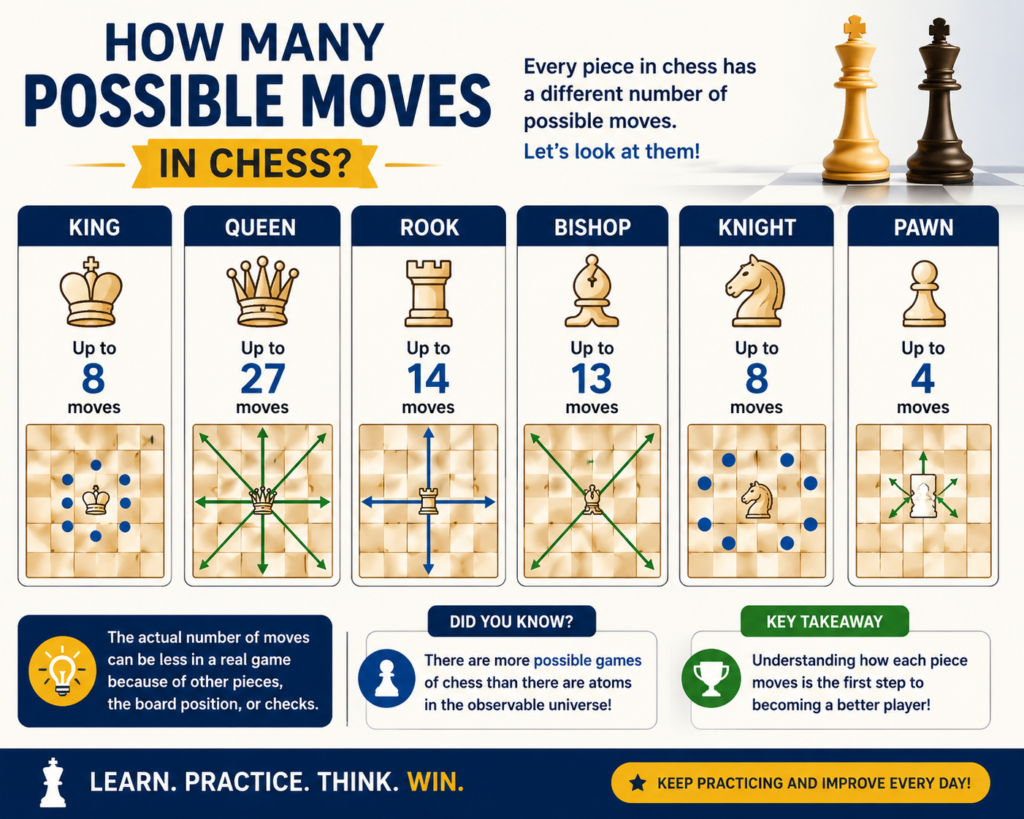
Chess captivates minds across centuries because its seemingly simple rules generate extraordinary complexity. When players ask “how many possible moves in chess,” they’re essentially asking about the mathematical universe underlying this ancient game. Understanding chess moves and their vast quantity reveals why mastering chess demands lifetime commitment despite its fundamental simplicity.
How many possible moves in chess exists varies significantly depending on context—whether discussing single positions, entire games, or theoretical variations. The sheer quantity of possible chess moves transforms chess from a solved problem into a virtually infinite exploration space. This article thoroughly examines chess move possibilities, providing comprehensive understanding of why chess remains genuinely challenging despite computational advances.
The answer to “how many possible moves in chess” encompasses multiple layers, each revealing different dimensions of chess complexity. From individual position variations to complete game lengths, the number of possible moves creates contexts where chess presents unprecedented cognitive challenges.
Understanding Basic Chess Move Mechanics
What Constitutes a Chess Move
Before calculating how many possible moves in chess exist, clarity about what comprises a move becomes essential. In chess terminology, a move represents one player’s turn—a single piece displacement from one square to another. Chess moves encompass all legal piece movements: pawn advances, piece captures, castling, and en passant pawn captures.
Possible moves available from any position depend entirely on that specific position’s configuration. Pieces blockaded by friendly pieces cannot move. Chess moves are further constrained by check situations—when the king is attacked, only moves eliminating the threat are legal. Understanding these constraints proves essential for calculating possible chess moves accurately.
Different positions generate vastly different quantities of available moves. An opened position with many piece mobility options permits numerous chess moves, while closed positions with restricted piece placement limit available moves substantially. This variation explains why calculating how many possible moves in chess requires specifying the position being evaluated.
Calculating Possible Moves in Starting Positions
Opening Move Quantities
From chess’s starting position, the first move possibilities appear modest. White possesses exactly 20 possible opening moves—sixteen pawn advances (each pawn can move one or two squares forward, creating two options per piece) and four knight moves (each of two knights can move to two different squares).
Black mirrors White’s options exactly, possessing identical move quantities for the opening. This 20-move choice for each player demonstrates that initial chess moves remain surprisingly limited. However, this modesty immediately explodes after White’s opening selection.
Rapid Move Complexity Growth
After White’s first move, Black confronts approximately 20 possible responses, resulting in roughly 400 different position possibilities after two initial moves. After White’s second move, position variations exceed 5,000 distinct possibilities. This exponential expansion demonstrates why calculating total possible chess moves becomes computationally challenging remarkably quickly.
By move ten, the number of distinct board positions exceeds millions. This dramatic growth illustrates why possible moves in chess cannot be simply summed—each move creates entire new branches of possibilities. Understanding this branching structure clarifies why calculating total chess moves requires sophisticated mathematical frameworks.
The Shannon Number and Move Complexity
Understanding Shannon’s Calculation
Claude Shannon, a legendary mathematician, proposed the famous “Shannon Number” estimating total possible chess games. Shannon calculated that approximately 10^120 different games could theoretically occur—a number so vast that comparison to atoms in the observable universe becomes instructive.
Shannon’s estimation involved multiplying the average number of possible moves per position by the average game length. Shannon estimated average positions permit roughly 30 legal moves, and average games last approximately 40 moves per player. This produces approximately 30^80 possible games—a number staggeringly larger than atoms in existence.
The Shannon Number reveals that “how many possible moves in chess” produces answers so enormous they transcend practical comprehension. Even supercomputers analyzing possible moves throughout entire games cannot explore anywhere near complete possibilities. This mathematical infinity defines chess’s fundamental challenge.
Modern Refinements to Shannon’s Estimates
Contemporary computer analysis has refined Shannon’s original estimates somewhat. Modern analysis suggests average positions permit between 30-35 legal moves, slightly higher than Shannon’s assumption. Game lengths similarly average slightly longer than Shannon estimated.
These refinements increase the total possible moves estimate to numbers even larger than Shannon’s original calculation. The adjusted figures demonstrate that calculating total chess moves produces increasingly astronomical quantities. Each refinement adds mathematical evidence that chess contains virtually infinite practical possibilities.
Average Moves Available in Different Positions
Middlegame Position Complexity
Middlegame positions usually have the most pieces on the board, so you typically have the most moves to choose from. Positions with numerous pieces interacting across open board areas might permit 40-50 possible moves or beyond. Some exceptionally open positions exceed 60 available moves.
The abundance of middlegame moves creates decision complexity that even computers struggle managing thoroughly. Calculating all possible responses to every available move exponentially increases computational burden. This move abundance explains why middlegame positions present greatest challenge to both human players and computer analysis.
Opening Phase Move Limitations
Opening positions, while featuring many pieces, constraint available moves significantly through positional considerations. Strong opening principles limit sensible chess moves dramatically. While technically 20+ moves may be legal in opening positions, competitive openings consider perhaps 5-10 sensible moves from master perspectives.
This distinction between legally possible moves and tactically sensible moves reveals chess complexity layering. Calculating how many possible moves in chess requires distinguishing theoretical possibilities from practical considerations. Opening theory effectively narrows move selection through accumulated strategic knowledge.
Endgame Position Constraints
Endgame scenarios, with fewer remaining pieces, typically restrict available moves compared to middlegames. King and pawn endgames might permit only 10-20 possible moves in any given position. Reduced piece quantity automatically limits move possibilities dramatically.
Paradoxically, while total available moves decrease in endgames, endgame complexity increases through forced sequences and precise calculations. Fewer possible moves create situations where single move errors prove decisive. This inverse relationship between move quantity and move importance characterizes endgame play.
Calculating Game Variation Complexity
Branching Factor Exponential Growth
How many possible moves in chess calculates not just through single positions but through game continuation variations. Each position’s possible moves create branches spawning entirely new position sets. This branching mechanism creates exponential complexity growth that dominates chess’s mathematical character.
If average positions permit 30 possible moves, then two consecutive moves generate 900 distinct position possibilities (30 × 30). Three consecutive moves create 27,000 variations (30 × 30 × 30). By move ten, variations exceed 590 quadrillion distinct possibilities. This exponential expansion reveals why total possible chess moves calculations produce staggeringly large numbers.
The branching factor represents chess’s complexity’s mathematical heart. Each position essentially opens 30+ new “universes” of possibilities. Possible chess moves don’t simply accumulate—they multiply exponentially across game progression. This structural reality explains chess’s seemingly inexhaustible depth.
Average Game Length Impact
Game length directly multiplies move quantity. Short games involving quick losses limit total possible moves substantially. Average games lasting 40-50 moves per player create vast move totals across game progressions. Theoretical maximum games approaching 5,000+ moves (though rare) would encompass move possibilities beyond calculation.
Calculating “how many possible moves in chess” depends substantially on whether calculation encompasses entire 40-move games or just single positions. A complete game analysis includes multiple position evaluations, each with distinct move possibilities. Extending analysis across game length multiplies complexity exponentially.
Computer Analysis and Move Calculation
Computational Capabilities and Limitations
Modern chess computers can analyze specific positions evaluating millions of possible moves per second. Supercomputers evaluate billions of moves in seconds through optimized algorithms. However, even these capabilities pale against total theoretical chess moves.
Deep Blue, which famously defeated Garry Kasparov, evaluated roughly 200 million chess moves per second. Despite this enormous computational capacity, Deep Blue necessarily restricted its analysis depth—it couldn’t explore all possible moves throughout entire games. Computational limitations necessarily restrict how thoroughly move possibilities can be evaluated.
Contemporary engines like AlphaZero and Leela Chess Zero employ neural networks evaluating position moves more selectively. Rather than brute-force calculating all possible moves, these engines prioritize likely move candidates. This approach acknowledges that calculating total chess moves exhaustively remains computationally impossible.
Why Complete Move Enumeration Proves Impossible
Calculating all possible moves throughout entire chess games exceeds any conceivable computational approach. The exponential branching creates numbers so vast that even partial enumeration demands impractical resources. Complete game analysis, accounting for every possible move across all variations, would require computation continuing far beyond the universe’s lifetime.
This computational impossibility means chess retains genuine mystery despite centuries of study. Possible moves outnumber any researcher’s lifetime analysis. This mathematical reality prevents chess from becoming “solved” despite computers achieving superhuman play levels.
Positional Evaluation and Move Selection
Identifying Critical Moves Among Possibilities
While calculating all possible moves becomes impractical, players and engines prioritize evaluating the strongest moves. Strong position evaluation identifies which candidate moves deserve serious analysis. This selective approach dramatically reduces moves requiring thorough evaluation.
Chess engines typically evaluate 3-7 primary candidate moves deeply, rather than analyzing all 30-50 available moves equally. This priority system acknowledges that calculating all possible moves equally would waste computational resources on obviously inferior choices. Intelligent move selection improves analysis efficiency.
The Concept of Move Quality
Not all possible moves deserve equal analysis. Quality varies dramatically among legal moves. Some moves clearly lose material or position immediately. Others represent sensible strategic approaches. Master evaluation identifies strongest candidate moves among available possibilities.
Understanding that move quality differs fundamentally from move quantity represents crucial chess comprehension. Calculating “how many possible moves in chess” matters less than determining which moves represent genuine alternatives deserving serious evaluation. This distinction separates superficial counting from practical chess understanding.
Opening Theory and Move Reduction
How Opening Theory Constrains Possible Moves
Opening theory effectively narrows possible moves from the overwhelming theoretical quantity to practically manageable subsets. Centuries of accumulated knowledge establish which moves represent sensible opening approaches. This theoretical refinement reduces move evaluation from 20-30 theoretical possibilities to perhaps 3-5 serious options in typical positions.
This move reduction demonstrates how chess knowledge constrains raw possibilities into practically meaningful selections. Opening databases catalog billions of games, providing patterns establishing which moves historically prove strongest. Players leverage this knowledge to eliminate obviously inferior moves without extensive calculation.
Transposition Tables and Move Repetition
Chess positions sometimes recur through different move orders. Opening transpositions—reaching identical positions through different move sequences—mean analyzing all variations of reaching that position would wastefully duplicate analysis. Transposition tables store position evaluations, enabling computers to reuse analyses across different move paths reaching identical positions.
This efficiency mechanism acknowledges that while possible moves create theoretical complexity, actual game positions often recur. Recognizing position equivalence despite different move histories substantially reduces unnecessary re-calculation. Transposition awareness reveals hidden efficiency within chess’s apparent move quantity.
Unique Positions Versus Possible Moves
Distinguishing Position Count from Move Count
Important distinction separates possible moves from possible positions. While moves create branching variations reaching new positions, the total unique positions prove smaller than move total. Some positions appear multiple times through different move sequences (transpositions).
Research estimates approximately 10^50 unique chess positions—substantially less than possible moves within games. This position reduction means not every chess move leads to entirely novel territory; many move sequences converge on previously reached positions. Understanding this distinction clarifies chess’s actual complexity versus theoretical calculations.
The 50-Move Rule and Threefold Repetition
Chess rules limiting games through repetition and draw conditions further constrain actual position possibilities. The 50-move rule eliminates stalemate possibilities after 50 consecutive non-capturing moves. Threefold repetition rules prevent infinite position cycling.
These rules acknowledge that unlimited move continuation could create infinite games. Rule constraints ensure that despite possible moves theoretical infinity, actual games remain finite. These practical limitations intersect mathematics with chess rules governing playable contests.
Why Understanding Move Complexity Matters
Strategic Decision-Making Foundation
Understanding “how many possible moves in chess” provides perspective on strategic decision-making. Accepting that complete move analysis proves impossible liberates players from perfectionism paralysis. Players recognize that identifying strong candidate moves matters more than cataloging every possible move.
This realization improves decision quality by focusing effort on distinguishing strong from weak moves rather than exhaustively analyzing every option. Strategic thinking emphasizes move evaluation over move enumeration. Understanding complexity demonstrates wisdom in selective analysis.
Appreciating Chess Depth
Comprehending the staggering quantity of possible moves deepens chess appreciation. The virtually infinite move possibilities explain why master players dedicate lifetimes to chess without exhausting discovery. New positions continually emerge throughout chess history, creating fresh challenges despite identical rules spanning centuries.
This recognition that “how many possible moves in chess” produces incomprehensibly large numbers inspires chess passion. The game’s mathematical depths mirror its beauty—infinite possibility within elegant rule simplicity. Understanding this complexity-from-simplicity relationship captures chess’s essential character.
Motivation for Continued Improvement
Knowing that complete chess mastery proves mathematically impossible creates paradoxical motivation. Rather than discouraging effort, this realization liberates players toward continuous improvement without unrealistic perfection expectations. Every player, regardless of strength level, confronts incompleteness.
Even Garry Kasparov, widely recognized as chess’s greatest player, never solved chess completely. Understanding that “how many possible moves in chess” vastly exceeds any individual’s lifetime analysis explains this reality. This perspective converts impossible perfection into sustainable motivation toward incremental mastery.
Mathematical Extensions and Variations
Chess Variants and Modified Rule Sets
Alternative chess variants create entirely different move possibility calculations. Fischer Random Chess randomizes starting position, altering opening move calculations dramatically. Chess variants using larger boards or additional pieces multiply possible moves exponentially.
These variants demonstrate that move quantity depends fundamentally on specific rule structures and board configurations. Understanding base chess moves provides foundation for analyzing how variations alter complexity. Different chess formats present different move calculation challenges.
Three-Dimensional Chess and Theoretical Extensions
Science fiction explorations of three-dimensional chess multiply possible moves beyond standard chess calculation. Three-dimensional configurations multiply position dimensions, increasing available moves at every position substantially. Theoretical explorations of chess in expanded dimensions reveal mathematics underlying chess complexity.
While impractical for actual play, three-dimensional analysis demonstrates how move possibilities scale with dimensional expansion. These theoretical extensions clarify that chess’s complexity represents general principle about game design rather than accident of specific rules.
Conclusion: The Infinite Game Within Finite Rules
How many possible moves in chess ultimately produces an answer transcending practical comprehension: infinity, or at minimum, numbers so vast that practical limitation matters more than theoretical total. From the opening’s modest 20 possible moves to middlegame positions offering 50+ options, chess accommodates sufficient variation to occupy humanity eternally.
Understanding chess move quantity reveals paradox underlying chess’s nature—simultaneously bound by elegant simplicity and containing virtually infinite complexity. The same rules governing a beginner’s first game generate positions confounding the world’s strongest computers. This combination of accessibility and depth defines chess’s universal appeal.
The question “how many possible moves in chess” has no satisfying simple answer. Instead, the answer deepens appreciation for the game’s mathematical foundations. Whether calculating moves from specific positions or considering complete game variations, chess demonstrates that genuine complexity can arise from rule simplicity.
This understanding transforms how players approach chess. Rather than seeking complete knowledge of all possible moves, effective players develop judgment distinguishing strong moves from weak, knowledge emphasizing quality over quantity. The infinity of chess moves becomes motivation for lifelong learning rather than obstacle to enjoyment.
Whether casual player or chess professional, appreciating the staggering move quantity underlying chess creates respect for the game’s depths. How many possible moves in chess ultimately matters less than recognizing that chess contains sufficient variety to inspire continuous discovery, improvement, and wonder across generations.
Pingback: King Chess Moves: Complete Guide to Mastering Royal Piece Movement Introduction: Understanding the Most Important Piece - Chess Next Move - Best next move calculator