
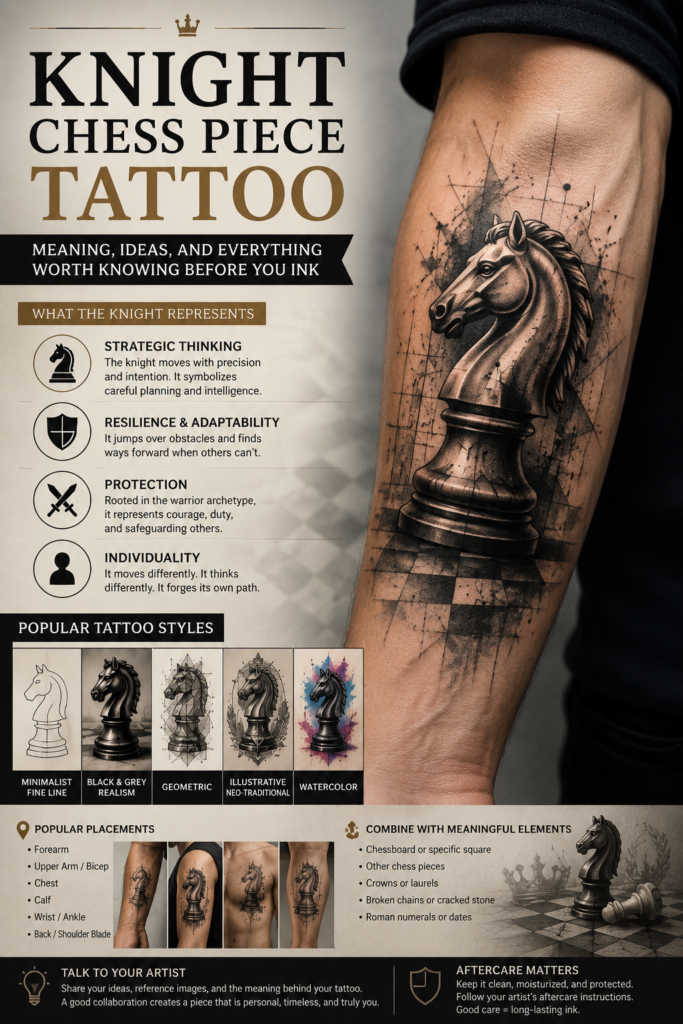
The world of tattoo art is full of symbols that carry deep personal weight, and the knight chess piece tattoo has quietly become one of the more meaningful choices people are making today. It is not just a design that looks striking on skin; it carries layers of symbolism, personal narrative, and artistic appeal that make it genuinely compelling. Whether someone is a chess enthusiast or simply drawn to what the knight represents, this tattoo tells a story worth exploring.
What Makes the Knight Chess Piece So Symbolically Rich?
Before anyone sits in a tattoo chair, it helps to understand why the knight holds such a distinct place in chess, and by extension, in tattoo culture. Among all chess pieces, the knight is the only one that does not move in a straight line. It jumps in an L-shape, leaping over obstacles and other pieces on the board. That movement alone has made it a powerful symbol for people who see themselves as unconventional thinkers or those who have found their own way around life’s obstacles.
A chess knight tattoo often carries the following meanings:
- Strategic thinking: The knight requires careful planning to use well. People who identify as calculated decision-makers often connect with this piece.
- Resilience and adaptability: Because the knight can move when others cannot, it represents flexibility in difficult situations.
- Protection: In medieval imagery, the knight is a warrior and protector. A chess piece tattoo of the knight merges that warrior archetype with the intellectual elegance of the game.
- Individuality: Choosing a path that others do not see is at the heart of what the knight does on the board, and many people carry that meaning personally.
Who Typically Gets a Knight Chess Piece Tattoo?
This is a tattoo that attracts a genuinely diverse group of people. Competitive chess players sometimes get a knight chess tattoo as a nod to their love of the game, particularly if the knight is their favorite or most-used piece in their playing style. Beyond dedicated players, the design appeals to:
- Writers and creatives who see themselves as moving around conventional paths
- Veterans and military personnel who connect with the warrior and protector symbolism
- Educators and thinkers who appreciate the intellectual tradition chess carries
- People who have overcome difficult personal chapters, using the knight’s ability to leap over obstacles as a personal metaphor
The chess knight tattoo, in this way, is less about one type of person and more about a universal feeling: the sense of moving through the world differently.
Popular Styles for a Knight Chess Piece Tattoo
One of the real strengths of the knight chess piece tattoo as a design choice is how well it translates across different tattoo styles. The shape of the knight, with its distinctive horse-head profile and base, gives tattoo artists a strong visual foundation to work with.
Minimalist and Fine Line
A minimalist chess knight tattoo typically focuses on the clean outline of the piece, keeping details sparse and lines thin. This style suits people who want something subtle, elegant, and discreet. Fine line work can capture the silhouette of the knight beautifully without adding heavy shading or complex fill.
Black and Grey Realism
For those who want depth and visual impact, a black and grey realism take on the knight chess piece tattoo can turn the piece into something almost three-dimensional. Tattoo artists working in this style often add texture to the marble or wood grain of the piece, making it look like the actual object rendered on skin.
Geometric
A geometric chess knight tattoo pairs the chess piece silhouette with sharp angles, dot work, and geometric patterns. This style appeals to those who want something modern and structured, blending the intellectual nature of chess with a visual style that feels contemporary.
Illustrative or Neo-Traditional
In illustrative styles, the knight chess piece takes on more character. Some artists incorporate medieval imagery around it, such as shields, swords, or banners, turning the chess piece tattoo into a more detailed narrative piece. Neo-traditional styles add bold outlines and rich tonal contrast.
Watercolor
A watercolor take on the knight chess piece tattoo brings softness and fluidity to an otherwise structured image. The sharp profile of the knight contrasts beautifully against washes of color bleeding around it.
Placement Ideas for a Chess Knight Tattoo
Placement is often as personal as the design itself. The knight chess piece tattoo works well in a variety of locations depending on size and style:
- Forearm: A popular choice for people who want their tattoo visible and accessible. The elongated shape of the chess piece fits naturally along the forearm.
- Upper arm and bicep: Gives room for larger, more detailed versions of the design.
- Chest: A central placement that can carry deeper personal meaning, especially for people who associate the knight with protection or strength.
- Calf: The vertical lines of the chess piece sit well on the calf, especially in black and grey or geometric styles.
- Wrist or ankle: Better suited for small or minimalist versions of the chess knight tattoo.
- Back or shoulder blade: Opens up possibilities for larger, more elaborate designs incorporating additional elements.
Combining the Knight with Other Elements
Many people choose to build a more layered design around the core knight chess piece tattoo. Some meaningful additions include:
- A chessboard or specific square: Grounding the piece in the context of the game
- Other chess pieces: Creating a full board scene or pairing the knight with the king or queen for personal relationship symbolism
- Crowns or laurels: Reinforcing themes of leadership and victory
- Broken chains or cracked stone: Adding the theme of breaking through barriers, which pairs naturally with the knight’s unique movement
- Roman numerals or dates: Personalizing the piece to mark a specific moment of significance
What to Discuss with a Tattoo Artist
Getting a knight chess piece tattoo done well depends heavily on the conversation someone has with their artist before the session. A few things worth discussing:
Reference images: Bringing in several references, both of chess pieces and of the style someone wants, helps the artist understand the vision clearly.
Sizing: The level of detail that works for a small chess piece tattoo is very different from what is possible in a larger piece. Some fine details that look great at scale become muddy when shrunk down.
Long-term aging: Certain styles, like watercolor or fine line, age differently than bold black and grey work. A good artist will always factor this into their recommendations.
Personalization: Sharing the personal meaning behind the choice often helps artists bring something genuine to the design rather than working purely from generic templates.
What the Knight Represents Beyond Chess
It is worth noting that the chess knight carries associations that stretch well beyond the game. In Western history, knights were figures of duty, honor, and skilled combat. In literature and storytelling, the knight archetype represents someone who protects others, acts with courage, and remains principled under pressure.
A chess piece tattoo of the knight, in that sense, sits at the intersection of two powerful traditions, the intellectual and the heroic. By blending rigid rules with infinite creative possibilities, the symbols of the game carry a weight and story that simpler icons can’t achieve.
For people who have served in the military, worked in high-stakes careers, or navigated deeply personal battles, the chess knight tattoo can carry all of that weight in a single, clean design.
Caring for a New Knight Chess Piece Tattoo
Once the tattoo is done, proper aftercare is what protects that investment. Some general points worth knowing:
- Keep the area clean and moisturized during the healing period, typically two to four weeks
- Avoid direct sun exposure on new ink, and use sunscreen on healed tattoos when outdoors
- Do not pick or scratch during the peeling phase, even when it becomes tempting
- Follow the specific aftercare instructions the tattoo artist provides, since recommendations can vary by style and skin type
A tattoo in a high-movement area, like the wrist or inner elbow, may need a touch-up after healing since the skin flexes more during recovery.
Final Thoughts
The knight chess piece tattoo earns its popularity for real reasons. It is visually strong, intellectually grounded, and personally flexible enough to carry different meanings for different people. Whether someone connects with the strategic mindset, the warrior symbolism, the idea of moving through obstacles in a way others do not expect, or simply the clean aesthetic of a chess piece as art, this is a tattoo design that ages well, both on skin and in meaning.
Anyone considering a chess knight tattoo is making a choice that rewards thought, just like the piece itself.
Pingback: Hermes Chess Set: A Closer Look at One of the Most Luxurious Board Games Ever Made - Chess Next Move - Best next move calculator
Pingback: How to Castle in Chess: A Complete Guide for Every Player - Chess Next Move - Best next move calculator