
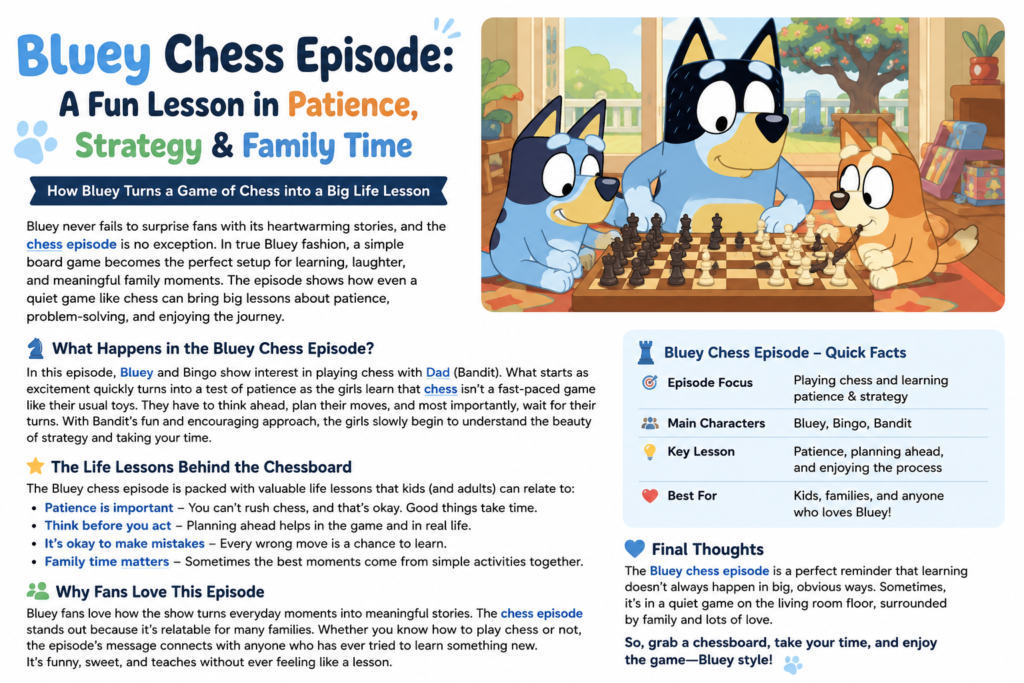
If anyone thought a seven-minute animated kids’ show couldn’t deliver a genuinely moving lesson about growing up, the Bluey chess episode is here to prove otherwise. Season 3, Episode 11, officially titled “Chest,” is one of those rare television moments that works on multiple levels at once. It makes children laugh, makes parents tear up, and somehow manages to sneak in a surprisingly accurate chess tutorial along the way.
What Is the Bluey Chess Episode About?
The story begins with Bandit (Dad) trying to teach Bluey how to play chess, while Chilli (Mum) quietly doubts whether Bluey is old enough for the game. Things get more interesting when Bingo joins in, and the two kids start making up their own rules. Even with their creative workarounds, neither of them can beat Dad. IMDb
The episode earns its title from a running gag that immediately sets the tone. Bluey and Bingo keep calling the game “chest” rather than “chess,” and they also consistently refer to the pawns as “prawns,” a mix-up so contagious that Bandit himself slips up and says “prawns” at one point. It is the kind of small, silly detail that feels completely true to how young children actually talk, and it is a big part of why the episode connects so well with families. TV Tropes
How the Kids Reimagine Every Chess Piece
One of the most charming parts of the Bluey chess episode is watching Bluey and Bingo refuse to accept the standard names for any of the pieces.
The knight becomes a “horsey,” with Bingo naming hers “Gallahop” and Bluey calling her own “Daughter of Gallahop.” The rook gets renamed “Castle Head,” and the bishops become “pom-pom elves.” Bandit tries repeatedly to correct them, but eventually he gives up fighting the nicknames and just rolls with it, which is very much in character for the show’s version of fatherhood. Subs like Script
The chess pieces also take on benign, friendly personalities in the kids’ version of the game. The queen, who can move anywhere on the board, simply wants to go on a picnic. One knight is actually friends with a pawn on the opposing team, and their “prawn children go to kindy together.” It is chaotic, it is funny, and it is also a completely believable snapshot of imaginative play. TV Tropes
The Chess Moves Are Actually Correct
Here is something that surprised quite a few people who watched the Bluey chess episode expecting a loose, cartoon-ified version of the game.
Chess enthusiasts who reviewed the episode noted that not a single mistake was made in setting up the board or moving any of the pieces throughout the entire episode. The rules Bandit explains, including how pawns move forward one square (or two on their first turn) and capture diagonally, are accurate. The way pieces are taken, the role of the queen, and the logic of protecting pieces all hold up under scrutiny. Chess.com
There is also a clever cultural reference tucked in: Chilli calls Bandit “Deep Blue” when he starts getting frustrated, nodding to the famous IBM chess-playing computer that became the first machine to defeat a reigning world chess champion. It is the kind of adult-facing detail that flies over younger heads while giving parents something to smile about. IMDb
Chilli’s Four-Move Lesson That Isn’t Really About Chess
The emotional centre of the Bluey chess episode arrives when Bluey, completely stuck and unable to beat her dad, calls on Mum for help.
Chilli promises she can beat Bandit in four moves, and in a technical sense, she actually loses the game very quickly. But the four moves double as a conversation that disarms Bandit entirely. He realises he doesn’t just want his girls to be smart. He wants them to be self-reliant and ready for a life in which their parents won’t always be there. TV Tropes
Chilli’s moves on the board run alongside a quiet but powerful message she delivers: the kids are little prawns right now, but one day they will be queens. She won’t always be there to protect them, so they will have to look after themselves, but for now, she will do everything she can to help them. Fandom
So while she loses the chess game in four moves, she wins the real argument entirely. She beats her husband on a moral level, not a strategic one. TV Tropes
Why the Bluey Chess Episode Resonates With Parents
Children’s television often tries to sneak lessons into stories, and the results are usually obvious and a little clunky. What makes the Bluey chess episode work differently is that the lesson doesn’t feel inserted. It evolves from the situation.
Chilli’s parting line to Bandit captures the whole thing in one sentence: “Work on their heads later. For now, just hearts.” It is a reminder that teaching a child to think strategically is a worthy goal, but making sure they feel loved and supported comes first. IMDb
For parents watching, this lands with a particular weight because the show never overplays it. The kids are already off playing with the chess pieces in the background, turning captured pawns into guests at a pool party, completely unaware of the conversation their parents just had. Life moves on around the moment, which makes the moment feel even more real.
A Quick Look at the Episode’s Reception
The episode holds an 8.4 rating on IMDb, which puts it comfortably among the more highly regarded entries in the series. Chess fans who stumbled across it described it as cute, funny, and only eight minutes long, noting that the humour starts immediately when the kids begin calling it “chest.” IMDbChess.com
The Bluey chess episode also managed to earn genuine appreciation from the chess community, which is not something most animated children’s shows can claim. The accuracy of the gameplay, combined with the warmth of the storytelling, made it a small but memorable crossover moment between two very different audiences.
What Makes “Chest” One of Season 3’s Standout Episodes
Season 3 of Bluey is widely considered some of the show’s strongest work, and “Chest” is a solid reason why. It takes a simple premise (Dad wants to teach chess, kids aren’t ready) and finds genuine emotional depth in it without abandoning the comedy.
The chess lesson turns into something much more imaginative, with Bluey and Bingo playing a version involving prawns, pom-pom elves, and castle heads, and yet the episode never loses sight of what it actually wants to say. The balance between the silly surface and the sincere core is what Bluey, as a series, does better than almost anything else in children’s television right now. Bluey
For families who haven’t watched it yet, the Bluey chess episode is a good place to start. It doesn’t require any prior knowledge of the show, it’s over in under eight minutes, and it will likely make the adults in the room feel something they didn’t expect from a cartoon about a Blue Heeler puppy playing chess.
Pingback: Knight Chess Piece Tattoo: Meaning, Ideas, and Everything Worth Knowing Before You Ink - Chess Next Move - Best next move calculator