
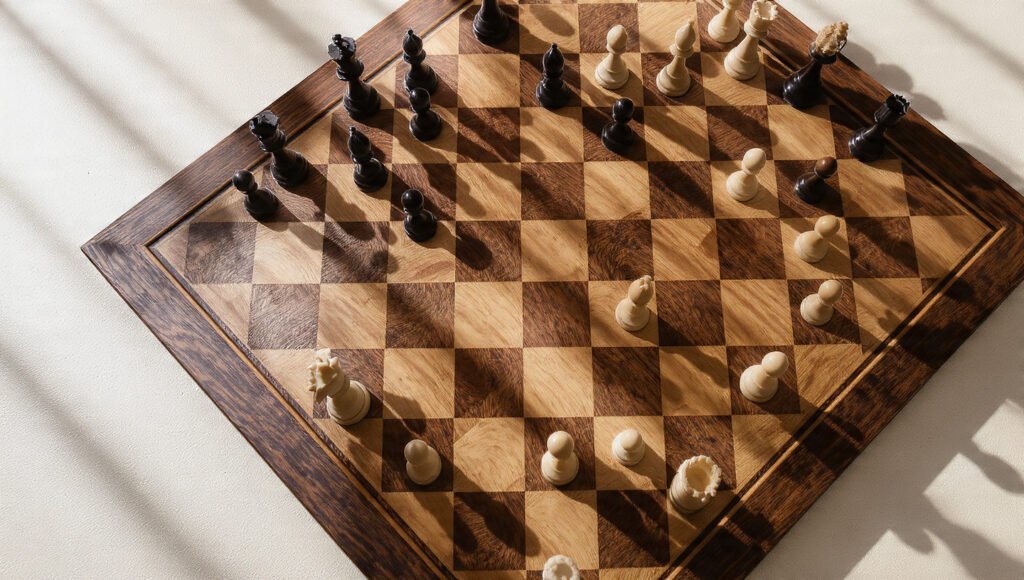
There is something almost magical about a chess board with pieces set up and ready to play. The neat rows of carved figures, the alternating light and dark squares, the quiet sense of possibility before the first move is made — it all adds up to one of the most iconic images in the history of games. For over a millennium, chess has captivated players worldwide, and the sight of a perfectly arranged board is just as mesmerizing today as it was centuries ago.
But for anyone new to the game — or even for casual players looking to sharpen their understanding — knowing exactly what goes on that board, where each piece belongs, and what role every piece plays is absolutely essential. This guide covers everything there is to know about the chess board with pieces, from the layout of the squares to the identity and placement of every single figure on the board.
Understanding the Chess Board Itself
Before placing a single piece, it helps to understand the board on which the whole game takes place. A standard chess board is a square grid made up of 64 squares — eight rows and eight columns. The squares alternate between two colors, traditionally referred to as light squares and dark squares, though the exact colors can vary depending on the set. Classic wooden boards often use cream and brown, while decorative sets might use white and black or even more creative color combinations.
Ranks and Files
The chess board is organized using a coordinate system that every chess player should know:
- Files run vertically from one player’s side to the other. There are eight files, labeled a through h from left to right from White’s perspective.
- Ranks run horizontally across the board. There are eight ranks, numbered 1 through 8 from White’s back row to Black’s back row.
This system means every single square on the board has a unique name. For example, the square in the bottom-left corner from White’s perspective is a1, and the square in the top-right corner is h8.
Diagonals
Diagonals are lines of squares that run at 45-degree angles across the board. They are particularly important for bishop and queen movement. Some diagonals are long — running from one corner of the board to the other — while others are short, covering just two or three squares.
Board Orientation
One detail that beginners often get wrong is board orientation. A chess board should always be placed so that each player has a light square in the bottom-right corner. A simple way to remember this is the phrase: “light on right.” If the board is set up incorrectly, the pieces will be on the wrong colored squares, which actually matters for certain pieces like the bishops.
The Chess Pieces: Names, Appearance, and Starting Positions
A complete chess board with pieces includes 32 pieces in total — 16 for White and 16 for Black. Each side has the following:
- 1 King
- 1 Queen
- 2 Rooks
- 2 Bishops
- 2 Knights
- 8 Pawns
Each piece has a specific starting position on the board, and setting up the board correctly before a game is part of learning the game properly. Here is a detailed breakdown of where every piece goes and what it looks like.
Setting Up the Back Rank: The Major and Minor Pieces
The first rank (Row 1 for White, Row 8 for Black) is where the major and minor pieces are placed at the start of the game. This row is sometimes called the back rank or the home rank.
The Rooks
The rooks — sometimes called castles because of their tower-like appearance — go in the corner squares of the back rank. For White, that means a1 and h1. For Black, it is a8 and h8.
Rooks are typically among the tallest pieces in a chess set (after the king) and have a distinctive flat-topped, battlemented shape that makes them easy to recognize.
The Knights
Moving inward from the rooks, the knights are placed on the b and g files. For White, that is b1 and g1; for Black, b8 and g8.
Knights traditionally look like horse heads in most chess sets, making them one of the most visually distinctive pieces on the board. They are also among the most beloved pieces because of their unique movement — the only piece that can jump over others.
The Bishops
Next to the knights, on the c and f files, sit the bishops. White’s bishops start on c1 and f1; Black’s bishops start on c8 and f8.
Bishops are typically slender, tall pieces with a pointed top, often featuring a notch or slit that has become a defining characteristic of the classic Staunton chess set design. One bishop always sits on a light square and the other on a dark square — and they stay on those colors for the entire game.
The Queen
The queen is placed on the d file — specifically d1 for White and d8 for Black. A key rule for remembering queen placement is that the queen goes on her own color: White’s queen starts on a light square (d1 is a light square), and Black’s queen starts on a dark square (d8 is a dark square).
The queen is usually the second-tallest piece on the board and is often crowned with a more elaborate design compared to the king. In most Staunton-style sets, the queen’s crown has multiple small points or a decorative sphere at the top.
The King
The king takes the remaining square on the back rank — e1 for White and e8 for Black. Like the queen, the king is placed on a specific color: White’s king starts on a dark square and Black’s king starts on a light square.
The king is typically the tallest piece in the set and is topped with a cross in traditional Staunton design. Despite being the most important piece in the game — the one that must be protected at all costs — the king is actually one of the least mobile pieces during most of the game.
The Second Rank: The Pawns
Once the back rank is filled with the major and minor pieces, the pawns line up across the entire second rank. For White, all eight pawns sit on the second rank (a2 through h2). For Black, the pawns fill the seventh rank (a7 through h7).
Pawns are the smallest and most numerous pieces on a chess board with pieces. In most chess sets, they are short, simple figures with a round head — unassuming in appearance but absolutely vital in practice. Pawns form the structural foundation of the game, shaping the pawn structure that determines much of the strategic character of each position.
A Visual Overview of the Starting Position
Here is a simple text representation of how a fully set-up chess board with pieces looks from White’s perspective:
8 | ♜ ♞ ♝ ♛ ♚ ♝ ♞ ♜ (Black)
7 | ♟ ♟ ♟ ♟ ♟ ♟ ♟ ♟
6 | . . . . . . . .
5 | . . . . . . . .
4 | . . . . . . . .
3 | . . . . . . . .
2 | ♙ ♙ ♙ ♙ ♙ ♙ ♙ ♙
1 | ♖ ♘ ♗ ♕ ♔ ♗ ♘ ♖ (White)
-------------------------
a b c d e f g h
(Uppercase = White pieces; lowercase = Black pieces. R=Rook, N=Knight, B=Bishop, Q=Queen, K=King, P=Pawn)
Rows 3 through 6 are completely empty at the start of the game — that open territory is where the battle will eventually unfold.
Choosing a Chess Set: What to Look For
For anyone shopping for a chess board with pieces, there are a few things worth considering. Chess sets come in a wide variety of styles, materials, and price ranges. Whether you are looking for a durable plastic set for club tournaments, a classic wooden board for your living room, or a premium weighted masterpiece, finding the right fit depends entirely on your taste, purpose, and budget.
Materials
- Wood: The most traditional and popular material for serious players. Wooden sets range from affordable options in basic woods to high-end sets crafted from rosewood, ebony, or maple.
- Plastic: Durable and affordable, plastic sets are practical for tournament play and school chess programs. The iconic Staunton-style plastic set used in most club and tournament settings is a great all-around option.
- Marble or Stone: These decorative sets are beautiful display pieces but are generally too heavy for comfortable play.
- Metal: Stylish and distinctive, metal chess sets are often collector’s items rather than practical playing sets.
Piece Size and Board Proportion
When selecting a chess board with pieces, it is important that the piece size matches the board size. A general guideline is that the king’s base diameter should take up roughly 75–80% of a single square. Oversized pieces that overlap squares or tiny pieces that get lost on a large board both make for an uncomfortable playing experience.
Weighted vs. Unweighted Pieces
Many quality chess sets feature weighted pieces — pieces with a metal disc or filling inside the base that gives them a satisfying heft and stability on the board. Weighted pieces are far less likely to tip over and generally feel more premium to handle.
The Role Each Piece Plays on the Board
A chess board with pieces is not just a visual arrangement — it is a carefully balanced system where each piece has a defined role.
- Pawns control space, open or close lines, and can become queens if they reach the far end of the board.
- Rooks dominate open files and ranks, especially in the endgame.
- Knights excel in closed positions and are the only pieces that can jump over others.
- Bishops control long diagonals and work best when those diagonals are unobstructed.
- The Queen combines the power of the rook and bishop, making it the most versatile and dangerous piece on the board.
- The King must be protected early but becomes a powerful active piece in the endgame.
Mastering the unique value and role of every piece empowers you to make smarter tactical decisions. It guides you on where to position them, when to execute a strategic trade, and how to orchestrate them as a unified team.
Final Thoughts
A chess board with pieces is far more than a game set — it is a world of strategic depth packed into 64 squares and 32 figures. From the way the board is oriented to the exact square where each piece begins, every detail matters. Players who take the time to truly understand the board layout and the identity of each piece give themselves a meaningful head start in learning one of the world’s greatest games.
Whether someone is setting up their very first chess board or rediscovering the game after years away, there is always something new to appreciate in that familiar arrangement of pieces waiting for the opening move.
Pingback: White Openings Chess: A Complete Guide to the Best First-Move Strategies for White - Chess Next Move - Best next move calculator