
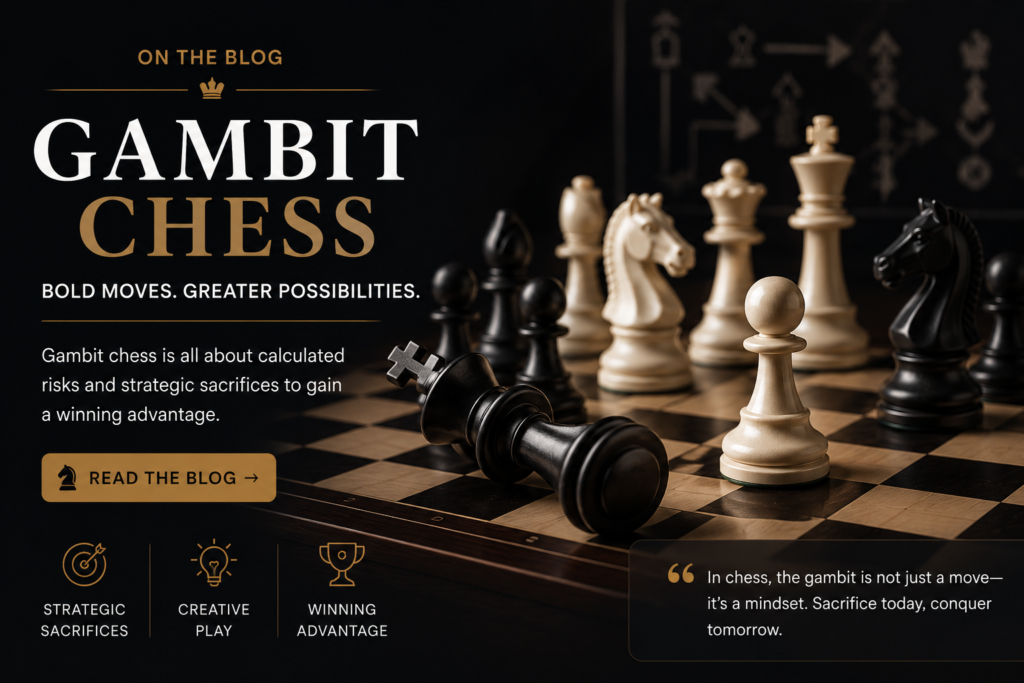
Gambit chess represents one of the most intellectually thrilling aspects of the ancient game, embodying the principle that sometimes losing material early can lead to devastating long-term advantages. A gambit chess strategy fundamentally challenges conventional wisdom about material equality, inviting players to embrace risk, creativity, and tactical brilliance. Throughout chess history, gambit chess has captivated players from beginners learning their first opening moves to world champions orchestrating complex attacking sequences.
Understanding Gambit Chess: The Foundation of Strategic Sacrifice
At its core, gambit chess involves voluntarily sacrificing material—typically a pawn, sometimes a piece—early in the game to gain positional or tactical advantages. Unlike blunders where pieces are lost through oversight, gambit chess sacrifices are calculated exchanges where the player offering the gambit chess strategy believes the compensation justifies the material cost.
The philosophical foundation of gambit chess rests on the principle that chess is far more complex than simple material counting. While beginners learn that pieces have numeric values—a pawn equals one point, a knight or bishop equals three—gambit chess masters understand that initiative, attacking potential, and spatial control often outweigh these mathematical abstractions.
A gambit chess opening sets the tone for the entire game. By sacrificing material early, a gambit chess player seizes the initiative, forcing their opponent into reactive positions. The opposing player must decide whether to accept the gambit chess sacrifice or decline it, each choice leading down dramatically different strategic paths. This psychological dimension makes gambit chess particularly interesting—it’s as much about managing your opponent’s expectations as it is about objective board evaluation.
The History and Evolution of Gambit Chess
Gambit chess didn’t emerge suddenly but evolved gradually as chess theory developed across centuries. Early chess players, constrained by limited understanding of position evaluation, gradually recognized that certain material sacrifices could yield powerful attacking possibilities. By the medieval period, gambit chess concepts were already recognized, though not yet systematized.
The true golden age of gambit chess occurred during the Romantic Era of chess, roughly from the 1800s through the early 1900s. During this period, players like Adolf Anderssen, Paul Morphy, and Wilhelm Steinitz demonstrated the devastating potential of gambit chess strategies. Their brilliantly aggressive games, many featuring spectacular gambit chess sacrifices, captivated audiences and established gambit chess as a legitimate strategic approach worthy of serious study.
The rise of scientific chess in the 20th century somewhat diminished gambit chess’s popularity among elite players. The hypermodern school of thought, emphasizing positional understanding over aggressive attack, made certain classical gambit chess openings seem outdated. However, gambit chess never disappeared—it simply evolved, with stronger players discovering which gambit chess sacrifices truly compensated for material loss and which were merely unsound attacks.
Classic Gambit Chess Openings That Defined the Game
Several gambit chess openings have achieved iconic status through centuries of play and analysis:
The King’s Gambit: Perhaps the most famous gambit chess opening, the King’s Gambit (1.e4 e5 2.f4) invites Black to capture the f4 pawn. White accepts that in exchange for this gambit chess sacrifice, they gain rapid development, open lines toward Black’s king, and commanding central control. The King’s Gambit exemplifies aggressive gambit chess philosophy—immediate, direct, and demanding.
The Queen’s Gambit: While technically a Pawn Gambit rather than a piece sacrifice, the Queen’s Gambit (1.d4 d5 2.c4) represents the most popular gambit chess opening in modern practice. White sacrifices the c4 pawn to establish dominance in the center. The Queen’s Gambit demonstrates how gambit chess strategy evolved—it’s less about flashy attacks and more about subtle positional advantages.
The Scandinavian Gambit Chess Variation: This represents a less common but still relevant gambit chess approach where White responds to 1.e4 d5 with 2.exd5, accepting the gambit chess structure and leading to complex, theoretical battles.
The Italian Gambit: Featuring moves like 1.e4 e5 2.Nf3 Nc6 3.Bc4 Nf6 4.Ng5 d5, the Italian Gambit exemplifies how multiple gambit chess ideas can combine in a single opening, creating layers of tactical and strategic complexity.
The Albin Countergambit: Perhaps the most unusual gambit chess concept, Black responds to the Queen’s Gambit with a gambit chess counter-sacrifice, creating fascinating imbalance and complexity.
The Psychology Behind Gambit Chess Strategy
Gambit chess operates on multiple psychological levels, affecting both the player offering the gambit chess sacrifice and their opponent. The person playing gambit chess often experiences a sense of liberation—by accepting that material loss is acceptable, they free themselves from cautious calculation and can focus on creative attacking possibilities.
Conversely, accepting gambit chess sacrifices creates psychological pressure. The player facing a gambit chess attack must evaluate whether the compensation truly justifies the material deficit. Making this evaluation incorrectly carries serious consequences. This uncertainty makes gambit chess particularly effective at practical tournaments, where players face time constraints and must make complex judgments rapidly.
The mere offer of a gambit chess sacrifice can influence decision-making. Some players, unsure whether to accept, decline the gambit chess opening entirely. While this maintains material equality, it often yields the initiative to the gambit chess player, who achieves their strategic goals through acceptance or declination alike. This represents the subtle genius of gambit chess—creating favorable situations regardless of the opponent’s response.
Analyzing Gambit Chess: When Sacrifice Justifies the Strategy
Modern chess engines and analysis software have revolutionized how players evaluate gambit chess positions. Computer analysis provides objective assessment of whether particular gambit chess sacrifices are sound or merely aggressive-looking mistakes. This scientific approach has actually reinvigorated interest in gambit chess, as players discovered that many classical sacrifices rated by Romantic-era players held up to engine scrutiny.
A sound gambit chess strategy typically features several compensating factors:
Rapid Development: Gambit chess sacrifices often accelerate piece development, allowing quick deployment of forces toward critical squares.
Open Lines: Many gambit chess openings feature pawn sacrifices that open files or diagonals, providing attacking channels that the sacrificing player can exploit.
Kingside Attacks: Numerous gambit chess strategies focus on launching coordinated attacks against the opponent’s king, where the initiative and tempo prove more valuable than material.
Central Control: Some gambit chess sacrifices—particularly in the Queen’s Gambit—sacrifice wing pawns to establish overwhelming central superiority.
Tactical Opportunities: Gambit sacrifices often create multiple forcing threats, so the opponent never gets time to use their extra material.
Modern Gambit Chess in Professional Play
Contemporary chess at the highest levels maintains a complex relationship with gambit chess. While the hypermodern revolution pushed dramatic sacrifices into the background, elite players never abandoned gambit chess entirely. World champions from Kasparov to Carlsen have employed various gambit chess strategies when the position and circumstances warranted.
Modern gambit chess tends toward subtlety compared to historical romantic sacrifices. Rather than dramatic piece sacrifices, contemporary gambit chess often features prophylactic pawn sacrifices that improve piece placement or prevent opponent counterplay. This evolution reflects deeper chess understanding—today’s players recognize that forcing advantages emerge from superior piece coordination more than from tactical fireworks.
The Queen’s Gambit Declined represents perhaps the most frequently played gambit chess opening at the elite level. Subtle positional maneuvering has replaced the tactical complications that characterized earlier gambit chess theory, yet the fundamental principle remains unchanged—White accepts material loss for superior long-term prospects.
Learning Gambit Chess: Developing Understanding and Practical Skill
For players seeking to incorporate gambit chess into their repertoire, several approaches prove effective:
Study Classical Games: Examining games by players like Anderssen, Morphy, and Tal illuminates the principles underlying gambit chess strategy. While modern chess has evolved, understanding the foundational concepts provides essential context.
Analyze Engine Evaluations: Computer analysis clarifies which gambit chess sacrifices genuinely compensate for material and which merely look superficially attractive. This objective feedback accelerates learning.
Play Practical Games: Nothing substitutes for experiencing gambit chess positions firsthand. Playing gambit chess openings reveals the concrete reality of how attacks develop, how opponents defend, and where practical difficulties emerge.
Study Positional Compensation: Understanding what factors make gambit chess sacrifices worthwhile—initiative, space advantage, structural superiority—builds intuition for evaluating novel positions.
Gambit Chess for Different Skill Levels
Gambit chess serves different purposes depending on player strength:
Beginners: Learning early gambit chess concepts teaches that chess is multidimensional. Rather than memorizing material values, beginning players grasp that initiative and activity matter profoundly.
Intermediate Players: Intermediate-level gambit chess study provides concrete openings they can employ while building deeper positional understanding through practical experience.
Advanced Players: Elite gambit chess knowledge involves mastering subtle positions where small advantages accumulate through precise play rather than tactical fireworks.
The Enduring Appeal of Gambit Chess
Despite centuries of chess evolution, gambit chess remains perpetually relevant because it speaks to something fundamental about competitive strategy. The willingness to sacrifice short-term advantages for long-term superior positioning transcends chess—it appears in business, military strategy, and countless competitive domains.
Gambit chess also appeals to players’ aesthetic sensibilities. There’s something beautiful and bold about sacrificing material based on conviction and calculation. This romantic element explains why classical gambit chess games remain popular centuries after they were played, while many technically perfect games fade into obscurity.
Pingback: Horse Chess: The Knight's Strategic Mastery and Tactical Brilliance - Chess Next Move - Best next move calculator