
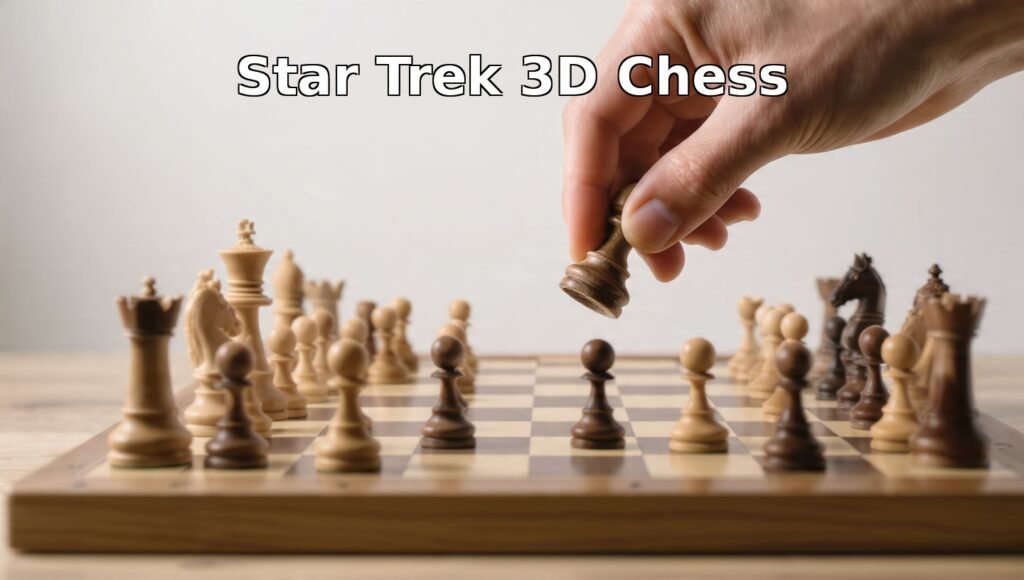
Few props in the history of science fiction television have captured the public imagination quite the way Star Trek 3D chess has. From its very first appearance on screen, that striking multi-level board sitting in the rec room of the USS Enterprise communicated something instantly compelling — that in the future, even the oldest and most beloved games would evolve into something far more complex, far more beautiful, and far more intellectually demanding than anything familiar today.
But Star Trek 3D chess is more than a clever piece of set design. It has grown into a genuine cultural phenomenon with its own rules, its own physical sets, its own digital adaptations, and its own dedicated community of enthusiasts. This guide covers everything worth knowing about the game — where it came from, how it works, how it fits into Star Trek’s universe, and why it continues to fascinate players and fans decades after its first appearance on screen.
What Is Star Trek 3D Chess?
The Basic Concept
Star Trek 3D chess — formally referred to within the franchise as Tri-Dimensional Chess, or Tri-D Chess — is a variant of standard chess designed to be played across multiple levels simultaneously rather than on a single flat board. Instead of moving pieces in two dimensions across a conventional 8×8 grid, players navigate pieces vertically as well as horizontally, creating a three-dimensional space of tactical possibility that standard chess simply cannot replicate.
The physical board used in Star Trek consists of three fixed primary playing levels stacked vertically above one another, plus four smaller platforms known as attack boards positioned at the corners of the arrangement. These attack boards are moveable — a feature that distinguishes Tri-D Chess from simpler stacked-board variants and adds a layer of dynamic spatial strategy to every game. The entire structure, rendered in transparent acrylic with a metallic frame in the original television prop, looks simultaneously futuristic and functional — a genuinely beautiful object that doubles as a remarkable conversation piece.
Why Three Dimensions?
The addition of vertical movement to chess is not a gimmick. In a three-dimensional chess game, pieces that would be blocked or out of range in a flat game suddenly gain access to entirely new lines of attack and defense. A Rook that cannot threaten a square on its own level might do so from the level above. A Bishop’s diagonal movement extends through multiple levels, creating threats that an opponent focused on horizontal play might not anticipate.
This expanded spatial thinking is exactly why Star Trek chose Tri-D Chess as the intellectual pastime of its most cerebral characters. Visually and conceptually, the game signals that its players are thinking on a strategic level most opponents never reach.
The History Behind Star Trek 3D Chess
Three-Dimensional Chess Before Star Trek
One of the most surprising things about Star Trek 3D chess is that the concept of three-dimensional chess did not originate with the show. Chess players and inventors had been experimenting with multi-level chess designs long before a single frame of Star Trek was ever filmed.
The earliest serious attempt at a three-dimensional chess system is credited to German chess master Lionel Kieseritzky in 1851, who proposed a vertically layered board with Greek symbols designating each level to allow for clear notation of cross-level moves. Decades later, a German physician and amateur inventor named Dr. Ferdinand Maack developed a three-dimensional chess variant called Raumschach — a name that translates with remarkable irony to “space chess” — around the turn of the twentieth century. Maack’s version used a five-by-five-by-five cubic playing space and attracted enough enthusiasts for him to establish a dedicated Raumschach club in Hamburg in 1919.
These early three-dimensional chess designs were intellectually serious attempts at expanding the game’s spatial complexity. They remained largely obscure outside of specialist circles, however, until a science fiction television program in the 1960s introduced the concept to a global audience and changed its cultural trajectory completely.
Star Trek’s Role in Popularizing the Game
When Star Trek first aired its second pilot episode — “Where No Man Has Gone Before” — audiences got their first look at the now-iconic Tri-D Chess board. The prop, designed to convey the intellectual sophistication of starship life in the 23rd century, immediately stood out. Here was a chess set that looked like it belonged in the future, constructed from gleaming transparent materials and arranged in a spatial configuration that standard chess could never produce.
The game became most closely associated with two characters in particular — Captain James T. Kirk and Science Officer Spock. Their recurring games of Tri-D Chess across the original series became some of the most memorable quiet moments in Star Trek storytelling, offering glimpses of the intellectual bond between the two characters outside of the drama of space exploration. Spock, with his Vulcan precision and mathematical mind, became the face of Tri-D Chess mastery in the cultural imagination — a player whose three-dimensional thinking extended seamlessly from the chessboard to the bridge of the Enterprise.
The game’s presence extended well beyond the original series. Subsequent Star Trek productions, including The Next Generation, Deep Space Nine, and Enterprise, all featured Tri-D Chess boards and gameplay in various episodes, cementing the game’s status as a defining element of the entire franchise’s visual and cultural identity.
How Star Trek 3D Chess Works
The Board Structure
The Tri-D Chess board consists of three primary fixed levels, each containing a standard arrangement of squares for piece placement and movement. The four attack boards — smaller four-square platforms — are attached at the corners of the primary levels but can be repositioned during play, adding a dynamic element absent from any conventional chess variant.
Each level is designated with a specific identifier to allow moves across levels to be accurately recorded and communicated. This notation system functions as a three-dimensional extension of conventional algebraic chess notation, adding a level coordinate to the standard file-and-rank designation that chess players already know.
Movement Across Levels
Every piece in Tri-D Chess retains its conventional movement abilities — a Rook still travels in straight lines, a Bishop still moves diagonally, and a Knight still executes its distinctive L-shaped hop. The fundamental difference is that these movements now extend across levels as well as across the flat plane of a single board.
A Queen, the most powerful piece in standard chess, becomes even more formidable in three-dimensional chess because her movement extends through all spatial directions simultaneously. She can sweep horizontally, vertically within a level, or diagonally across levels — making her coverage of the board dramatically more expansive than anything a flat-board player would expect.
The attack boards introduce a further layer of tactical depth. Moving an attack board during a turn constitutes a legal move and can dramatically alter the spatial relationships between pieces — opening new lines of attack, blocking existing threats, or repositioning a pawn into a more threatening location across the board’s levels.
Learning the Game
Players who already know conventional chess have a genuine head start in learning Tri-D Chess. The foundational movement rules remain unchanged, which means the primary learning curve involves developing spatial awareness across three dimensions rather than learning an entirely new game from the ground up. Most players find that the conceptual leap from two-dimensional to three-dimensional chess thinking takes time to develop but follows logically from the principles of the standard game.
Several different rulesets have been developed and circulated among Star Trek 3D chess enthusiasts over the decades, with variations proposed by fans, players, and chess variant designers at different points in the game’s history. The most widely referenced formal ruleset was developed by Andrew Bartmess, whose codification of Tri-D Chess movement and attack board mechanics gave the fan community a consistent framework to play and discuss the game.
Star Trek 3D Chess in Popular Culture
Beyond the Enterprise
The cultural footprint of Star Trek 3D chess extends well beyond the Star Trek franchise itself. References to the game and its distinctive multi-level board have surfaced across a remarkably broad range of television, film, and digital media. Shows from entirely different genres have used the Tri-D Chess board as a visual shorthand for exceptional intelligence — placing it on screen as a signal that a character thinks in dimensions others cannot follow.
The phrase “playing three-dimensional chess” has entered everyday language as a metaphor for someone who understands a complex situation on a level that leaves others far behind. Politicians, business strategists, and sports analysts use the expression regularly, almost always without realizing its direct origin in Star Trek’s iconic prop. That kind of cultural osmosis — from a television set piece to a mainstream idiom — speaks to just how deeply the image of Tri-D Chess has embedded itself in collective imagination.
Physical Sets and Digital Adaptations
For enthusiasts who want to experience Star Trek 3D chess beyond the screen, physical sets have been commercially available at various points in the game’s history. These sets, typically constructed from acrylic and metal in faithful reproduction of the original prop design, are prized both as functional gaming boards and as collector’s items. Real, high-quality Tri-D Chess sets sell for serious money with collectors, thanks to their craftsmanship and their place in Star Trek history.
Digital adaptations of the game have appeared across multiple platforms, including smartphone apps and browser-based implementations, making Tri-D Chess more accessible than it has ever been. These digital versions vary considerably in their ruleset implementation and visual presentation, from faithful recreations of the classic board to more experimental approaches that use the three-dimensional format as a foundation for new variant ideas.
Why Star Trek 3D Chess Still Matters
A Symbol of Intellectual Ambition
In a franchise built around the idea that humanity’s future is defined by curiosity, cooperation, and the relentless pursuit of knowledge, Star Trek 3D chess functions as more than a prop. It is a symbol — a physical representation of the idea that the minds of the future will think in broader, deeper, more spatially sophisticated ways than those of the present.
Every time Kirk and Spock settle in front of that multi-level board, the scene communicates something beyond the game itself. It suggests that the best kind of intelligence is not reactive but anticipatory — not responding to what is immediately in front of you, but thinking three moves ahead across dimensions your opponent hasn’t yet considered.
A Game Worth Playing
Decades after its television debut, Star Trek 3D chess remains one of the most recognizable and beloved elements of the entire franchise. Its combination of genuine intellectual depth, striking visual design, and rich cultural associations with some of the most beloved characters in science fiction history gives it a staying power that few props in any medium can claim.
For chess lovers, science fiction enthusiasts, and anyone who has ever looked at a flat chessboard and thought “what if there were more?” — Tri-D Chess offers something genuinely exciting. It is a game that rewards exactly the kind of thinking Star Trek has always championed: bold, multi-dimensional, and always looking further ahead than anyone else in the room.
Pingback: Foldable Chess Board: Your Complete Guide to the Smartest Chess Investment Any Player Can Make - Chess Next Move - Best next move calculator