
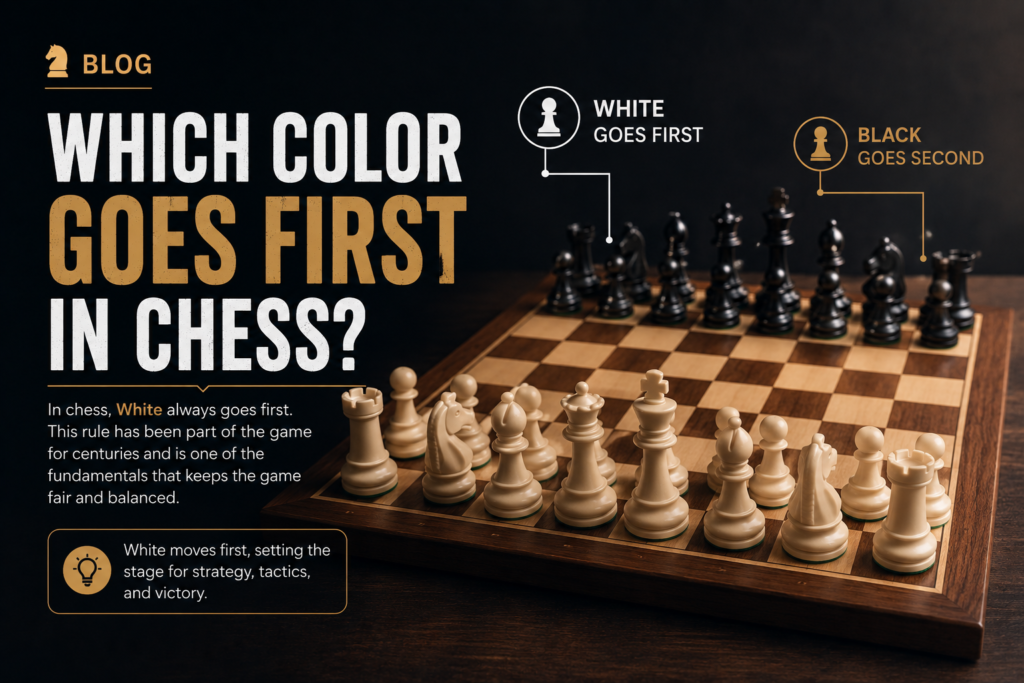
Almost everyone sitting down at a chess board for the first time asks the same thing: who moves first? The answer is straightforward on the surface. White always moves first. But the reasons behind that rule, the history that shaped it, and the real-world effect it has on competitive outcomes all make for a much richer story than the simple answer suggests.
This article covers everything worth knowing about the first move in chess, from the origins of the white-goes-first convention to the statistical edge it creates and what strong players do about it.
The Simple Answer: White Always Moves First
In every formal game of chess, at every level from casual play to world championship matches, white goes first in chess. This is a universal rule with no exceptions in standard play. White makes the opening move, Black responds, and the two players alternate from there until the game concludes.
This means which color goes first in chess is never a question that needs to be settled during the game itself. It is fixed by the rules. What does get determined before the game starts, particularly in competitive settings, is which player gets to sit with the white pieces.
How Players Are Assigned White or Black
Since white goes first in chess and that carries a recognized advantage at competitive levels, the assignment of colors is handled deliberately in different formats.
In casual games between two players who both want to play, the simplest method is a coin flip or drawing lots. One common informal approach is for one player to hold a pawn of each color behind their back and let the opponent choose a hand. Whichever color is revealed determines who plays white.
In organized tournaments, color assignment is handled by the tournament director according to pairing rules. Most standard tournament systems aim to give each player an equal number of games with each color across multiple rounds, or at least to ensure no player has the same color three times in a row.
In knockout matches and world championship contests, players alternate colors across games. If one player has white in game one, the other has white in game two, and so on. This ensures both players get equal access to white pieces in chess across the match as a whole.
The History Behind White Moving First
Which color goes first in chess has not always had the clear, fixed answer it has today. The history behind the rule is longer and more debated than many people expect. The original colors in chess were red and black, not white and black. Originally, either color could move first.
White going first was not even standard going into the late 19th century. The Immortal Game, one of the most famous chess games ever played, was played with Anderssen going first as the black pieces. White going first was not documented for tournament play until 1880 in New York. Wikipedia
Which Color Goes First in Chess? The push toward standardization came gradually. British master Johann Löwenthal made one of the first recorded proposals that White should always move first. At the First American Chess Congress, held in New York in 1857, Löwenthal sent letters to the secretary of the New York Chess Club citing the advisableness of always giving the first move, in published games, to the player of the white pieces. This rule was not immediately adopted, and tournament organizers maintained flexibility on the first move. Roadtorock
The formal adoption came a little later. In the Fifth American Chess Congress in 1880, it was written in the Code of Chess Laws: “The right of first move must be determined by lot. “The player having the first move must always play with the white men.” Wilhelm Steinitz, the first world champion, repeated this idea in his 1889 book “The Modern Chess Instructor,” where he wrote: “The players draw by lot for move and choice of color. In all international and public Chess matches and tournaments, however, it is the rule for the first player to have the white men.” History of Rock
From that point, the convention became standard across the chess world, and which color goes first in chess has had a consistent answer ever since.
Does Going First Actually Give White an Advantage?
This is where the question of which color goes first in chess becomes genuinely interesting from a competitive standpoint. Having the first move is not just a formality. It carries a measurable, documented advantage at every level of serious play.
Since 1475, white’s overall winning percentage has been approximately 55% in nearly one million games. This includes the percentage of total wins plus half the percentage of drawn games. Britannica
White consistently wins slightly more often than Black, usually achieving a winning percentage between 52 and 56 percent. White’s advantage is less significant in blitz games and games between lower-level players, and becomes greater as the level of play rises. However, stronger play also leads to more draws.
Looking at specific opening choices, the numbers break down further. White scored 54.1% with 1.e4 and 56.1% with 1.d4.
. One reason 1.e4 showed a slightly lower score is the Sicilian defense, where White only scored 52.3%. TeachRock
Even when removing human players from the equation entirely, the pattern holds. Computer chess engines show this advantage consistently. In tests where strong chess engines play each other, White consistently scores around 54% to 55%, even at different game speeds. TeachRock
What Does White’s First Move Actually Provide?
Understanding which color goes first in chess leads naturally to asking what the first move actually gives the player who makes it. A few concrete benefits are worth explaining.
Initiative and Tempo
The most fundamental advantage of the first move in chess is initiative. White gets to set the tone before Black has made a single decision. White can stake out central squares, develop pieces toward active positions, and begin building a plan from the very first move. Black must react to what White does before establishing its own agenda.
In chess, a “tempo” refers to a single move’s worth of time. By moving first, White is effectively one tempo ahead throughout the opening. That small head start allows White to complete development slightly faster and reach active positions before Black can do the same.
Choice of Opening
White also gets to choose the opening structure for the game. Playing 1.e4, 1.d4, or any other first move immediately defines the type of position that is likely to arise. White can select openings that suit its preparation and playing style. Black must have answers prepared for multiple possible White first moves, which places a broader theoretical burden on the Black player.
Psychological Pressure
At higher levels of play, white pieces in chess carry an implicit expectation of pressing for a win. White is expected to try to maintain an initiative throughout the game, while Black is often considered to have done well by achieving a draw against well-prepared opposition. This psychological dimension influences decision-making throughout a game and forms part of why the color assignment matters to professionals.
How Black Responds to the First Move Disadvantage
Despite the numbers, black pieces in chess are far from helpless. The history of chess is full of Black victories at every level, and the world’s best players have developed sophisticated systems specifically designed to neutralize White’s early initiative and create winning chances of their own.
The Sicilian Defense, which begins with 1.e4 c5, is the single most popular response to White’s most common first move precisely because it avoids symmetry and creates immediate imbalance. Rather than matching White’s central pawn with a mirror move, Black fights for the center from a different angle and creates positions where both sides have winning chances.
Similarly, defenses like the King’s Indian, the Nimzo-Indian, and the Grünfeld all represent sophisticated Black systems built around the idea that allowing White an early central presence is acceptable as long as Black retains active piece play and counterattacking chances.
The practical takeaway is that while which color goes first in chess matters, the first move advantage is small enough that skill, preparation, and decision-making over the board outweigh it in the vast majority of games.
Does Perfect Chess Always Favor White?
A natural question that follows from all of this is whether chess is, at its theoretical core, a first-player win. If White’s initiative is real and measurable, does perfect play by both sides guarantee a White victory?
Chess players and theoreticians have long debated whether, given perfect play by both sides, the game should end in a win for White or a draw. Since approximately 1889, when World Champion Wilhelm Steinitz addressed this issue, the consensus has been that a perfectly played game would end in a draw. History of Rock
This is the majority view among chess theorists and top-level players. The first move provides a genuine but limited advantage. With best play from both sides, that advantage is not enough to force a win against a correctly responding opponent. Chess is therefore believed to be a theoretical draw, even though White’s initiative creates practical winning chances across real games.
How Colors Are Managed in Major Tournaments
In practice, how chess color rules operate across a full tournament matters as much as the rules themselves. The most widely used pairing systems in competitive chess, such as the Swiss system and round-robin formats, each handle color assignment differently.
In Swiss system tournaments, the pairing software tracks each player’s color history and attempts to equalize colors over the course of the event. A player who has had white three times in a row will generally receive black in the next round, all else being equal.
In round-robin events, where each player faces every other player twice, one game is played with each color, giving every participant equal access to the first move advantage over the full event.
In world championship matches, the reigning champion or a coin toss before the match determines who gets white in the first game, with colors alternating from there. This ensures the question of which color goes first in chess is answered fairly across the full span of play.
A Note on Chess Variants and Color Conventions
Some chess variants handle the first move in chess differently from the standard game. In certain speed chess formats and online casual play, the color assignment is handled automatically by the platform, often alternating between games in a series. Some experimental variants have explored giving Black the first move to test how the game dynamics change, though these remain outside mainstream competitive chess.
For all standard, officially recognized chess, the answer to which color goes first in chess remains exactly what it has been since the late nineteenth century. White moves first, every time.
Final Thoughts
Which color goes first in chess is one of those questions with a deceptively simple answer that opens into a genuinely interesting history and a body of statistical and theoretical knowledge worth understanding. White goes first, always, under the rules that were formally established in the 1880s and have remained consistent ever since.
That first move in chess carries a real but modest advantage, documented across millions of games and backed by over a century of data. It shapes opening preparation, influences psychological dynamics, and sets the tempo of every game played. But it does not determine outcomes on its own. The richness of chess lies precisely in the fact that a small structural advantage at move one still leaves an enormous space for skill, creativity, and competitive play to decide what actually happens.
Pingback: How to Play Chess for Beginners: The Complete Step-by-Step Guide - Chess Next Move - Best next move calculator