
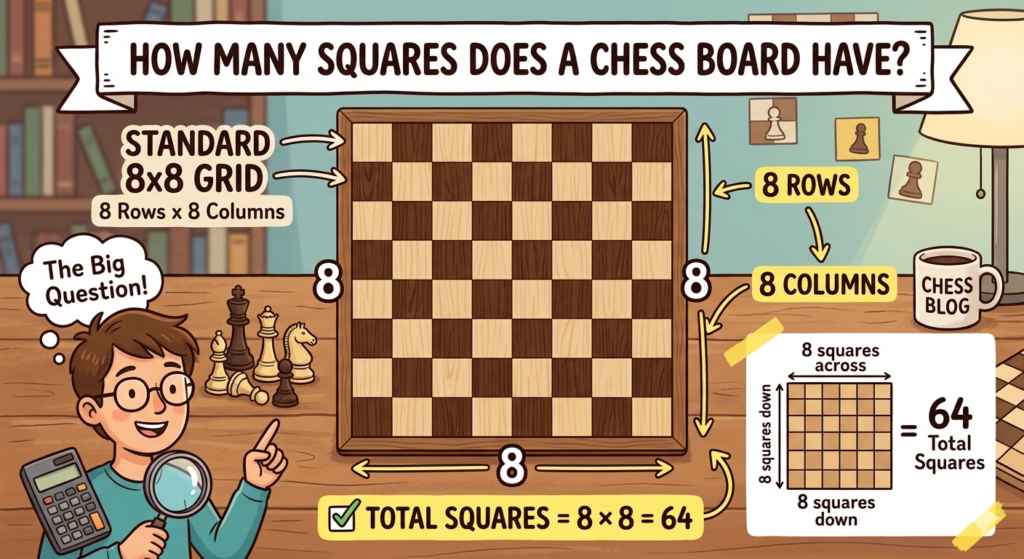
Chess is one of the oldest and most intellectually stimulating board games in the world. People have been playing it for centuries, and yet, one deceptively simple question continues to puzzle both beginners and seasoned players alike .How many squares are on a standard 8×8 chessboard?
At first glance, the answer seems obvious. But once someone starts counting carefully, they quickly realize the question is far more interesting than it appears.
The First Instinct: Counting the Obvious
When most people look at a chessboard and ask how many squares does a chess board have, their immediate answer is 64. And honestly, that’s a reasonable starting point. A standard chessboard is laid out in an 8×8 grid, which gives 64 individual unit squares — 32 light-colored and 32 dark-colored alternating squares.
But here’s where things get fun. A chessboard isn’t just made up of those tiny 1×1 squares. It’s also made up of larger squares formed by combining multiple smaller ones. So the real answer to how many squares does a chess board have goes well beyond 64.
Breaking It Down: All the Different Square Sizes
To figure out the true total, one needs to consider every possible square size that can be formed on a standard 8×8 chessboard. Let’s walk through them one by one.
1×1 Squares
These are the most obvious ones — the individual cells of the chessboard. There are exactly 64 of these squares. Simple enough, right?
2×2 Squares
Now, consider a square that covers 2×2 cells. How many such squares can fit on the board? Sliding this square across the board horizontally, it can occupy positions 1 through 7 along the top row — that’s 7 positions. The same applies vertically. So the total is 7×7 = 49 squares of size 2×2.
3×3 Squares
Using the same logic, a 3×3 square can shift 6 positions horizontally and 6 positions vertically. That gives 6×6 = 36 squares of this size.
4×4 Squares
For a 4×4 square, the number of positions drops to 5 in each direction, giving 5×5 = 25 squares.
5×5 Squares
Moving along the pattern, 5×5 squares fit in 4 positions each way — 4×4 = 16 squares.
6×6 Squares
A 6×6 square can slide into 3 positions horizontally and 3 vertically — 3×3 = 9 squares.
7×7 Squares
With only 2 positions available in each direction, there are 2×2 = 4 squares of size 7×7.
8×8 Squares
The largest possible square on the board is the full 8×8 grid itself. There is exactly 1 square of this size.
The Grand Total: Adding It All Up
Now, here’s the satisfying part. Adding all those numbers together:
| Square Size | Count |
|---|---|
| 1×1 | 64 |
| 2×2 | 49 |
| 3×3 | 36 |
| 4×4 | 25 |
| 5×5 | 16 |
| 6×6 | 9 |
| 7×7 | 4 |
| 8×8 | 1 |
| Total | 204 |
So the correct and complete answer to how many squares does a
board have is 204 squares — not just 64.
The Mathematical Formula Behind the Count
For those who enjoy numbers, there’s actually a neat mathematical formula that makes this calculation much easier. The total number of squares on an n×n board is given by the sum of squares formula:
Total = n(n+1)(2n+1) / 6
For a standard 8×8 board:
Total = 8 × 9 × 17 / 6 = 1224 / 6 = 204
This formula works for any board size, making it a handy trick to keep in mind. For example, if someone ever wonders how many squares are on a 4×4 board, the formula gives: 4 × 5 × 9 / 6 = 30 squares.
Why Does This Question Matter?
At this point, some readers might wonder — why does any of this matter beyond satisfying a fun curiosity? As it turns out, this question pops up in several important contexts.
Chess Education and Pattern Recognition
Understanding the layered structure of a chessboard helps players think in terms of zones, regions, and control. When a chess coach teaches a student about controlling the center or understanding spatial dominance, they’re essentially talking about squares within squares. Recognizing that there are 204 overlapping squares on the board builds a deeper appreciation for how complex the game truly is.
Mathematics and Problem-Solving
The chessboard square problem is a classic example used in mathematics education to teach combinatorics and the concept of counting systematically. Teachers often use it to show students how breaking a problem into smaller parts and looking for patterns leads to elegant solutions.
Job Interviews and Brain Teasers
Tech companies, consulting firms, and finance houses are known for throwing brain teasers at candidates during interviews. “How many squares does a chess board have?” is one of those classic lateral-thinking questions. Interviewers aren’t just looking for the answer — they’re watching how a candidate approaches the problem, breaks it into parts, and communicates their reasoning.
Common Mistakes People Make While Counting
A lot of people get tripped up on this question, and it’s completely understandable. Here are the most common errors:
Stopping at 64
The most frequent mistake is answering 64 and moving on. The person assumes they’ve been asked about the number of cells, not the number of squares of all sizes. Once someone realizes that larger squares exist within the board, the question becomes a lot more interesting.
Forgetting the Largest Square
Surprisingly, many people who try to count all sizes forget to include the full 8×8 board itself as a square. It seems too big and obvious, but it absolutely counts.
Miscounting the Sliding Positions
Another common error is getting the sliding positions wrong. For instance, when counting 2×2 squares, some people assume 8 positions instead of 7, arriving at 8×8 = 64 and getting confused. The key is remembering that a 2×2 square can start at column 1 but not column 8, since it needs room to expand rightward.
Rectangles vs. Squares — A Related Puzzle
While on the topic, it’s worth mentioning a closely related question: how many rectangles are on a chessboard? This question is even more complex and gives a far larger number.
Any rectangle on the board is defined by choosing 2 vertical lines and 2 horizontal lines from the 9 lines that make up the grid. The number of ways to do this is:
C(9,2) × C(9,2) = 36 × 36 = 1,296 rectangles
Of these 1,296 rectangles, 204 are squares — which brings things back to the original answer nicely. Every square is a rectangle, but not every rectangle is a square.
The Chessboard as a Symbol of Complexity
There’s something philosophically beautiful about the chessboard. On the surface, it looks like a simple grid — 64 squares, alternating black and white, neat and orderly. But the moment someone starts to ask deeper questions about it, layers of hidden complexity begin to emerge.
In that way, the chessboard is a great metaphor for chess itself. The rules of the game can be learned in an afternoon, yet mastering it takes a lifetime. The board looks finite, but the number of possible games that can be played on it is greater than the number of atoms in the observable universe.
That same layered thinking applies to asking how many squares does a chess board have. What seems like a simple question leads to a journey through geometry, arithmetic, pattern recognition, and combinatorics — all from staring at a wooden grid.
Fun Facts About the Chessboard
To wrap things up on a lighter note, here are a few fun facts that chess enthusiasts and curious minds might enjoy:
- A standard chessboard has 8 rows (called ranks) and 8 columns (called files), creating the familiar 8×8 layout.
- The total number of possible chess games is estimated at around 10^120 — a number known as the Shannon number.
- The light square in the bottom-right corner of a properly set-up chessboard is always a light square, often remembered by the phrase “light on right.”
- Despite being just 64 visible cells, a chessboard contains 204 distinct squares of varying sizes when all combinations are considered.
- The chessboard pattern itself is used in optical illusions, photography calibration, and even computer vision algorithms.
Final Thoughts
So the next time someone casually asks how many squares does a chess board have, the answer is never as simple as it looks. Yes, there are 64 unit squares that most people see right away. But when every possible square of every size is counted — from 1×1 all the way up to the full 8×8 board — the real answer is a satisfying 204 squares.
It’s a question that turns a glance into a deep-dive, and a simple grid into a mathematical playground. Whether someone is a chess enthusiast, a student, a job seeker preparing for interviews, or just someone who loves a good brain teaser, understanding this answer is both impressive and genuinely rewarding.
Chess, after all, has always been about seeing what others don’t.
Pingback: Fairy Chess: The Magical World Beyond Standard Chess Rules - Chess Next Move - Best next move calculator