
Chess sits on an eight-by-eight board with 32 pieces and a fixed set of rules. It looks contained and finite. But when anyone starts asking how many possible chess moves there actually are, the answer moves well beyond anything that feels manageable. The number of chess moves and game variations is so astronomically large that it has genuinely puzzled mathematicians, computer scientists, and players for decades. This article walks through the full picture, from the very first move to the staggering totals that emerge when the whole game tree is counted.
The Starting Point: How Many Moves Does White Have on Move One?
The best place to begin understanding possible chess moves is at the very beginning of the game. Before a single piece has moved, the position is completely fixed. White sits to move, and the question is straightforward: how many legal options are available?
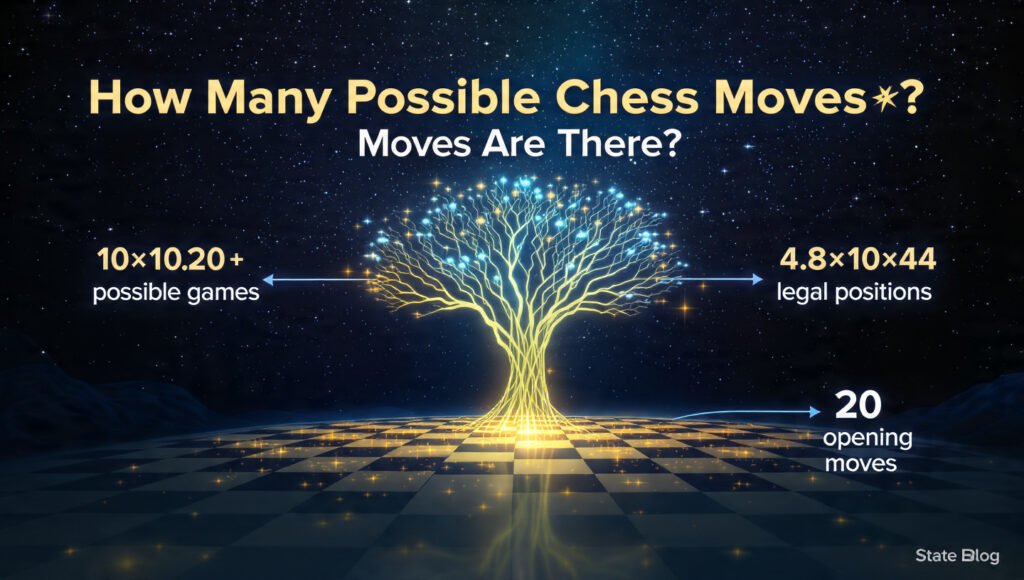
There are 20 possible first moves in chess: each of the eight pawns can move one or two squares forward, and each of the two knights has two squares it can go to. Chess.com
That is it. Twenty choices. No bishops, rooks, queens, or kings can move from the starting position because they are all blocked by pawns in front of them. The knights are the only pieces that can leap over other pieces, giving them those four available squares.
Black also has 20 possible replies to White’s opening move, which already gives 400 different possible board positions after the first pair of moves. SDLC Corp
So within two half-moves, the game has already branched into 400 distinct states. And this is just the beginning.
How the Number of Chess Moves Grows After the Opening
The 20-move figure for the first move is deceptively modest. As pieces begin to move and the board opens up, the number of chess moves available in any given position grows significantly.
Once pawns and knights have started moving, bishops, rooks, queens, and the king begin to play more active roles. Each additional piece that moves opens up new possibilities, leading to a substantial increase in the number of possible moves. A typical middlegame position has about thirty to forty legal moves. . House of Staunton
While averages hover around 30 to 40, there can be positions with an exceptionally high number of legal moves. The record for the most legal moves available from a single, albeit contrived, chess position is 218 moves. Ithy
That upper limit of 218 comes from constructed positions designed to maximize options rather than from practical game situations. In real competitive games, positions rarely approach anywhere near that number of possible chess moves simultaneously.
The Explosion After Five Moves Each
The rate at which possible chess games multiply is where the true scale of the problem becomes apparent.
After each player has moved a piece five times each, there are 69,352,859,712,417 possible games that could have been played. HandWiki
That is roughly 69 trillion unique game paths after just ten half-moves, or five moves per player. Most casual games run to 40 moves or more. The implications of that growth rate are staggering.
At depth 10 plies, equivalent to 5 full moves by each player, there are also 85,375,278,064 distinct reachable positions. Grokipedia
These are not theoretical or estimated figures. They are exact values calculated through a method called perft analysis, which counts every legal node in the game tree to a given depth without estimation or rounding.
The Shannon Number: The Total Count of Possible Chess Games
The most widely cited figure when people ask how many possible chess moves and games exist comes from the work of American mathematician Claude Shannon. In 1950, Shannon published a landmark paper titled “Programming a Computer for Playing Chess,” which introduced the concept of the game tree and attempted to quantify the total scope of chess.
The Shannon number is a conservative lower bound of the game-tree complexity of chess of 10 to the power of 120, based on an average of about 10 to the power of 3 possibilities for a pair of moves consisting of a move for White followed by a move for Black, and a typical game lasting about 40 such pairs of moves. Wikipedia
Shannon based his calculation on a logical approximation that each game has an average of 40 moves and each move a player chooses between 30 possible moves, making a total of 10 to the power of 120 possible games. This number is known as the number of Shannon. Chess.com
To put that number in perspective: the number of possible chess games is roughly 10 to the power of 120, a figure so vast that it exceeds the number of atoms in the observable universe. Enthu
The number of atoms in the observable universe is roughly estimated to be 10 to the power of 80. HandWiki
So the number of chess moves across all possible game sequences outnumbers the atoms in the entire observable universe by a factor of 10 to the power of 40. That is not a rounding difference. It is an incomprehensibly larger scale.
What About the Number of Possible Chess Positions?
There is an important distinction between the total possible chess games and the total number of distinct board positions. Two different game sequences can arrive at the same board position through different move orders, so positions and games are counted separately.
Shannon estimated the number of possible positions at roughly 10 to the power of 43. Taking captures and promotions into account, Victor Allis calculated an upper bound of 5 times 10 to the power of 52 for the number of positions and estimated the true number to be about 10 to the power of 50. Gambiter
With 95% confidence, John Tromp and Peter Österlund estimated the number of legal chess positions at approximately 4.822 × 10^44. Wikipedia
These estimates have been refined over time as computing power and mathematical tools have improved. The general consensus places the number of legal, reachable possible chess positions somewhere between 10 to the power of 44 and 10 to the power of 46, depending on the method used and whether all promotion scenarios are included.
Why Chess Cannot Simply Be Solved by Computers
A natural follow-up question to all of this is whether a computer could simply calculate every possible chess moves sequence and determine the perfect outcome for every game. The Shannon number answers that question clearly.
Shannon showed a calculation for the lower bound of the game-tree complexity of chess, resulting in about 10 to the power of 120 possible games, to demonstrate the impracticality of solving chess by brute force, in his 1950 paper. Wikipedia
Even the fastest computers in existence today could not evaluate 10 to the power of 120 positions within any reasonable timeframe. To understand why, consider that the universe itself is estimated to be around 4 times 10 to the power of 17 seconds old. No matter how quickly a computer processes positions, the sheer scale of chess game complexity makes complete brute-force analysis mathematically impossible with any technology imaginable today.
This is precisely why chess engines like Stockfish and Leela Chess Zero use selective search algorithms, evaluation functions, and pattern recognition rather than calculating every possible continuation. They explore the most promising possible chess moves in any given position rather than calculating all of them.
Allis’ Revised Estimate and Modern Calculations
Claude Shannon’s original estimate was deliberately conservative and served as a lower bound. Later researchers produced higher estimates by using more realistic assumptions about average game length and branching factors.
Allis estimated the game-tree complexity to be at least 10 to the power of 123, based on an average branching factor of 35 and an average game length of 80 moves. HandWiki
Chess has an estimated state-space complexity of 10 to the power of 46, and the estimated game tree complexity of 10 to the power of 123 is based on an average branching factor of 35 and an average game length of 80 ply. Chessprogramming
The difference between Shannon’s 10 to the power of 120 and Allis’ 10 to the power of 123 reflects more realistic assumptions about how long games actually run and how many genuinely distinct moves exist per position on average.
Every Game You Play Is Almost Certainly Unique
One of the most interesting practical implications of the number of chess moves and possible chess games is what it means for any individual game played anywhere in the world.
Every time a game of chess lasts 40 or more moves, one can be practically certain that no one in the history of time has played an identical game. Substack
Given that recorded chess history stretches back centuries and millions of games have been played and documented, this statement still holds up mathematically. The total number of games ever played in human history represents a fraction so small relative to 10 to the power of 120 that the probability of a genuinely identical unplanned game is effectively zero.
This is not an exaggeration for effect. It is a direct consequence of the chess game complexity numbers.
Branching Factor: The Engine Behind the Growth
The concept that drives all of these numbers is called the branching factor. It refers to the average number of legal possible chess moves available to a player at any given position.
The branching factor is the average number of legal moves per turn, which hovers around 30. While this varies based on the position, with some having only a few legal moves and others having over 100, this average branching factor leads to an explosion in possible game paths with each turn. SDLC Corp
Every time a player sits down to move, they are not choosing between two or three options. They are typically choosing from 30 or more legal continuations. Their opponent will then face a similar range of choices. That repeated branching, compounded across 40 to 80 moves, is what produces the astronomical number of possible chess games.
Comparing Chess to Other Games
It helps to place chess in context alongside other strategy games to appreciate just how large its chess game complexity really is.
Tic-tac-toe has approximately 255,168 distinct game sequences. Checkers has been solved completely by computer, with a game tree of roughly 5 times 10 to the power of 20. Chess at 10 to the power of 120 sits far beyond both.
Go, the ancient Asian strategy game played on a 19×19 board, actually surpasses chess in game tree complexity, with estimates ranging up to 10 to the power of 360 or higher. This is part of why Go was considered a significantly harder challenge for artificial intelligence than chess, and why it took longer for computers to reach and exceed human performance in that game.
What This Means for Players
For anyone who plays chess, the numbers behind possible chess moves carry a practical meaning that goes beyond abstract mathematics.
Preparation matters because positions repeat. Strong players study well-known opening lines, middlegame structures, and endgame techniques precisely because not every path through the 10 to the power of 120 game tree is equally likely. Human games cluster around well-understood positions, and recognizing those patterns is a trainable skill.
Creativity is always available. Because the total space of chess game complexity is so vast, genuinely novel ideas remain possible at every level of play. Even in positions that have been analyzed deeply, small differences in move order, piece placement, or pawn structure can lead into territory where existing knowledge runs thin.
No single player, and no engine, has exhausted what is available in possible chess positions. That is what makes the game endlessly engaging across every level of competition.
Final Thoughts
The question of how many possible chess moves exist leads into one of the most genuinely mind-expanding corners of mathematics. Starting from 20 legal opening choices, the game expands through a branching tree of roughly 30 options per move across a typical 40 to 80 move game, producing a total of at least 10 to the power of 120 possible game sequences .Possible Chess Moves / That number exceeds the atom count of the observable universe by an enormous margin and places chess firmly beyond any possibility of complete computational analysis.
Possible Chess Moves /Understanding this scale does not change the rules of chess or the way any individual game is played. But it does offer a useful reminder of why the game has remained interesting to generations of players, mathematicians, and programmers for over a thousand years. The number of chess moves is not just large. It is genuinely beyond full comprehension.
Pingback: EZ Chess: The Friendliest Way to Start Playing and Actually Enjoying the Game - Chess Next Move - Best next move calculator